
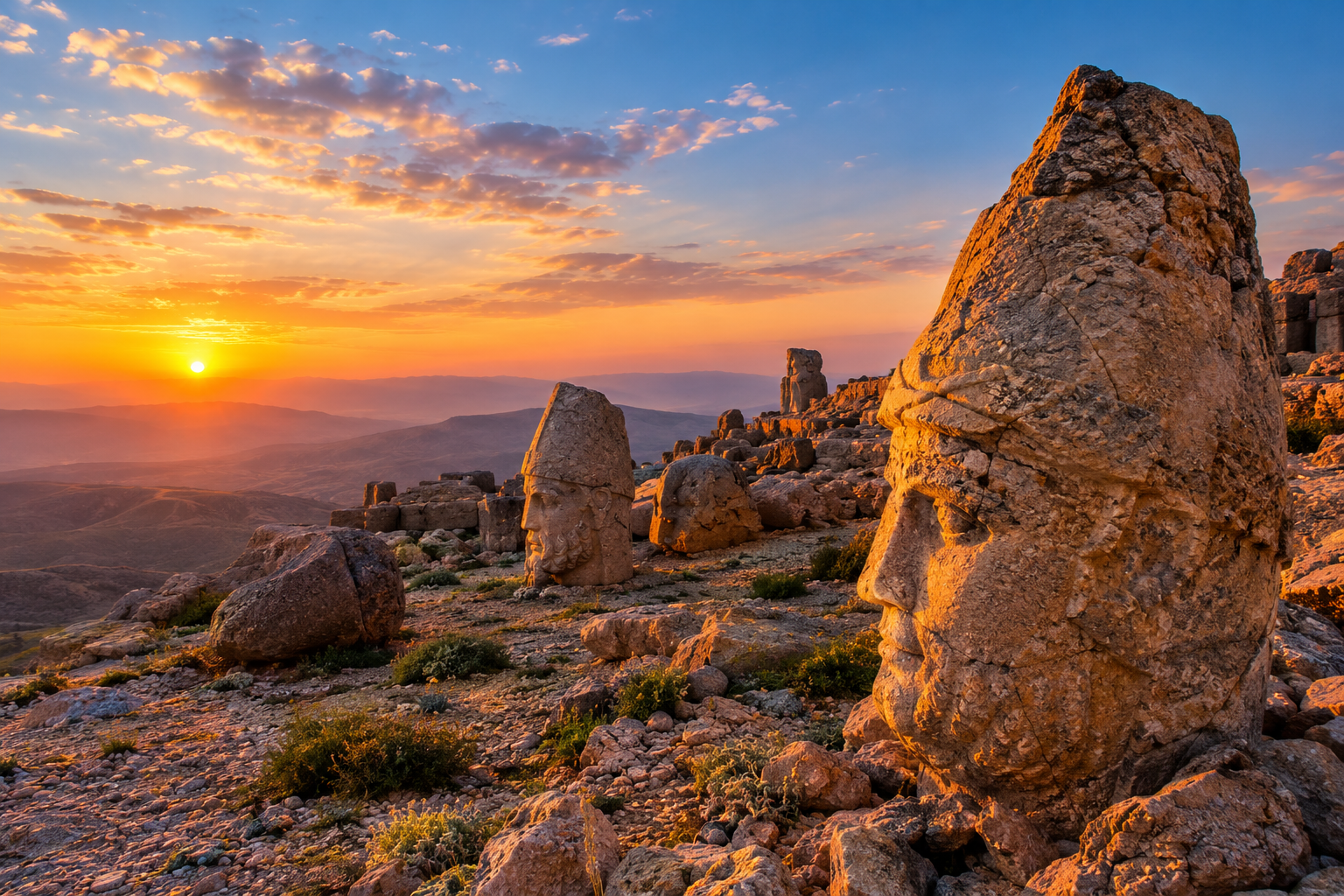
Some places make you want to take photographs, while others make you put your camera away and simply look around. Mount Nemrut in southeastern Turkey seems to offer both experiences. Imagine standing on a mountain before sunrise, with cold air around you and enormous stone heads resting on the ground. The sky is still dark, but a faint line of orange begins to appear beyond the distant hills. Slowly, the first light reaches the ancient statues. For a moment, it is easy to forget how much time has passed since they were created.
Mount Nemrut is not the kind of destination most travellers discover by accident. Reaching it takes some planning, and the journey can be tiring, especially if you want to arrive before dawn. Still, the mountain has a certain appeal that makes the effort worthwhile. It combines ancient history, dramatic scenery and the kind of quiet atmosphere that is becoming harder to find in popular tourist destinations.
Located in Adıyaman Province, southeastern Turkey, Mount Nemrut is best known for its enormous stone statues and royal burial sanctuary. The monument dates back more than 2,000 years, yet its presence still feels surprisingly powerful.
Where Is Mount Nemrut?
Mount Nemrut stands approximately 2,134 metres above sea level in the eastern Taurus mountain region. The surrounding landscape is rugged, with rocky slopes, deep valleys and small settlements scattered across the countryside.
Most visitors begin their journey from Kahta or Adıyaman. Both provide access to organised tours and private transport, although Kahta is a convenient base for exploring the surrounding historical attractions.
The road towards the summit is an experience in itself. As you travel higher, the scenery gradually changes. Villages become smaller in the distance, winding roads follow the mountain slopes, and wide valleys open up below. It is worth looking outside rather than spending the entire drive checking your phone.
The final section involves leaving your vehicle near the designated parking area and walking uphill towards the archaeological site. The path is manageable for most visitors, but the altitude and uneven ground can make it more demanding than expected.
The Story Behind the Giant Stone Heads
Long before Mount Nemrut became a destination for international travellers, it was an important royal sanctuary of the ancient Kingdom of Commagene.
King Antiochus I, who ruled during the first century BC, ordered the construction of an extraordinary monument at the mountain’s summit. His kingdom stood between the Greek and Persian worlds, and this mixture of cultures influenced the design of the sanctuary.
The monument was intended to preserve the king’s memory and connect his name with the gods. It included enormous statues representing figures such as Zeus, Apollo, Heracles and Antiochus himself. Lions and eagles were also part of the original arrangement.
Over the centuries, earthquakes and exposure to the elements caused many statues to collapse. Their enormous heads now rest separately from their bodies, creating the unusual scene that makes Mount Nemrut so recognisable.
There is something fascinating about these weathered faces. Their expressions are still visible, even after centuries of harsh winters and summer sunshine. When you look at them, you cannot help wondering about the people who carved them, the tools they used and what they imagined the mountain would look like in the distant future.
Sunrise at Mount Nemrut: The Moment Worth Waking Up For
Sunrise is one of the main reasons people make the journey to Mount Nemrut. Visitors often leave their hotels while it is still dark, hoping to reach the summit before the first light appears.
The waiting is part of the experience. The mountain feels different before sunrise. The air is cold, the landscape is difficult to see, and the stone figures look almost mysterious against the dark sky.
Then the colours begin to change.
A little orange appears on the horizon, followed by soft shades of pink and gold. The surrounding hills slowly become visible, and sunlight begins to fall across the ancient statues. Their rough surfaces take on a warmer colour, while the valleys below remain covered in morning shadows.
I imagine this would be one of those travel moments when you forget about taking the perfect photograph. You simply stand there, watching the light move across a place that has existed for thousands of years. There is no need to hurry. The mountain has seen countless sunrises before this one, and somehow that thought makes the moment even more special.
Sunset is another possibility if an early start does not appeal to you. The changing evening light creates long shadows across the terraces and offers a different view of the surrounding landscape.
One practical detail is easy to overlook: mornings can be surprisingly cold at this altitude, even in summer. A warm jacket is worth packing.
Exploring the Eastern and Western Terraces
The archaeological complex has two main sections, known as the Eastern and Western Terraces. Both deserve attention, and visiting them slowly makes it easier to appreciate the details.
The Eastern Terrace is particularly impressive for its arrangement of seated monumental figures. The remains of their bodies and the enormous heads lying nearby create an unusual scene against the open sky. You can also see the remains of the original altar and other architectural features.
The Western Terrace has its own collection of statues, including representations of the ancient gods and the king. It also contains important inscriptions that help explain the purpose and religious ideas behind the monument.
What I would enjoy most about walking between these areas is noticing the small details. A carved expression, a damaged inscription or the texture of an old stone can sometimes attract more attention than the monument as a whole.
Take a few photographs, of course, but leave yourself time to look around without a camera in your hand. The surrounding mountains are beautiful, and the open landscape gives the entire place a sense of space that photographs cannot always capture.
Other Places to Visit Near Mount Nemrut
If you are staying in the region for more than a day, there are several historical sites worth adding to your plans.
The Cendere Bridge is a remarkable Roman structure built across the Cendere Stream. Its stone arch and mountainous surroundings make it an interesting stop, particularly if you enjoy ancient engineering.
Karakuş Tumulus is another important monument connected with the royal family of Commagene. Its remaining columns and carved eagle figure provide another glimpse into the history of the kingdom.
You can also visit Arsameia, an ancient settlement associated with the Commagene rulers. The site contains inscriptions and carved reliefs that reveal more about the people who once lived in this part of Anatolia.
I would try to include at least one of these places during the trip. They add context to the visit and help you understand that Mount Nemrut was part of a much larger historical landscape.
Best Time to Visit Mount Nemrut
Late spring, summer and early autumn are generally the most suitable seasons, although weather and road conditions should always be checked before travelling.
May and June offer pleasant opportunities for exploring the surrounding region. September and October can also be attractive, especially for visitors who prefer milder daytime temperatures.
Summer is popular because of the longer days and better chances of clear skies, but afternoons can become very hot in southeastern Turkey. Winter is more challenging, as snowfall and difficult road conditions may affect access to the summit.
Comfortable walking shoes are essential. I would also carry drinking water, sunscreen, sunglasses and a small snack. There is little shade around the terraces, and you may spend longer exploring than originally planned.
Before setting out, check the latest opening arrangements, entrance fees and transport options. These details can change depending on the season.
Why Mount Nemrut Deserves a Place on Your Turkey Itinerary
Turkey has no shortage of memorable destinations. Istanbul offers historic neighbourhoods and impressive architecture, Antalya attracts visitors with its beaches, and Cappadocia is famous for its unusual landscapes. Mount Nemrut offers something rather different.
Here, the attraction is not a busy shopping street or a fashionable café. It is a mountain, a collection of ancient statues and a view that changes with every passing hour.
The destination is particularly appealing to people interested in archaeology, photography and ancient civilisations. Even if history is not your main interest, the natural surroundings alone make the journey worthwhile.
It is also a chance to discover southeastern Turkey, a region with its own traditions, food and historical character. Spending time in nearby towns can make the visit feel more complete than simply arriving for sunrise and leaving immediately afterwards.
A Place That Stays in Your Memory
Mount Nemrut is one of those destinations that deserves more than a quick visit. Its enormous stone heads, ancient terraces and beautiful mountain setting create an experience that feels quite different from ordinary sightseeing.
What I find most interesting is the thought that King Antiochus built this monument hoping to be remembered by future generations. More than two thousand years later, people are still making their way up the mountain to see what remains of his ambition.
If I were planning a journey through southeastern Turkey, I would certainly make room for Mount Nemrut. I would arrive before sunrise, explore both terraces and spend some time looking across the valleys rather than rushing back to the car.
Perhaps that is the real beauty of travelling to places like this. You come for the history, but you leave with memories of the quiet morning air, the changing colours of the sky and the sight of ancient stone faces beneath the open heavens. Some journeys end when you reach home. Others stay with you a little longer.
About Zoey
Zoey is a passionate global traveler and travel content creator dedicated to helping explorers navigate international destinations with smart planning, accurate budgets, and practical guides. Through detailed itineraries and destination insights, Zoey aims to make world travel accessible and stress-free everyone.


We visited at sunset where the opposite side is the viewing point.
Wow!
I didn’t know Turkey had giant stone heads too.
I just saw ‘Wild Horse 🐎 9’, with Sam Rockwell and John Malkovich.
Excelent movie 🎬 BTW.
But, to the relevance…
It takes place on Easter Island 🗿
The giant heads is, perhaps, the only thing people 🤔 think of when one says that name.
So, I guess its a testament to ALL that Turkey 🇹🇷 has to offer that (forgive me) I was unaware of this other site worth seeing.
Thank you for sharing.
This is most informative 👏
Mount Nemrut at sunrise is fascinating, Zoey!