
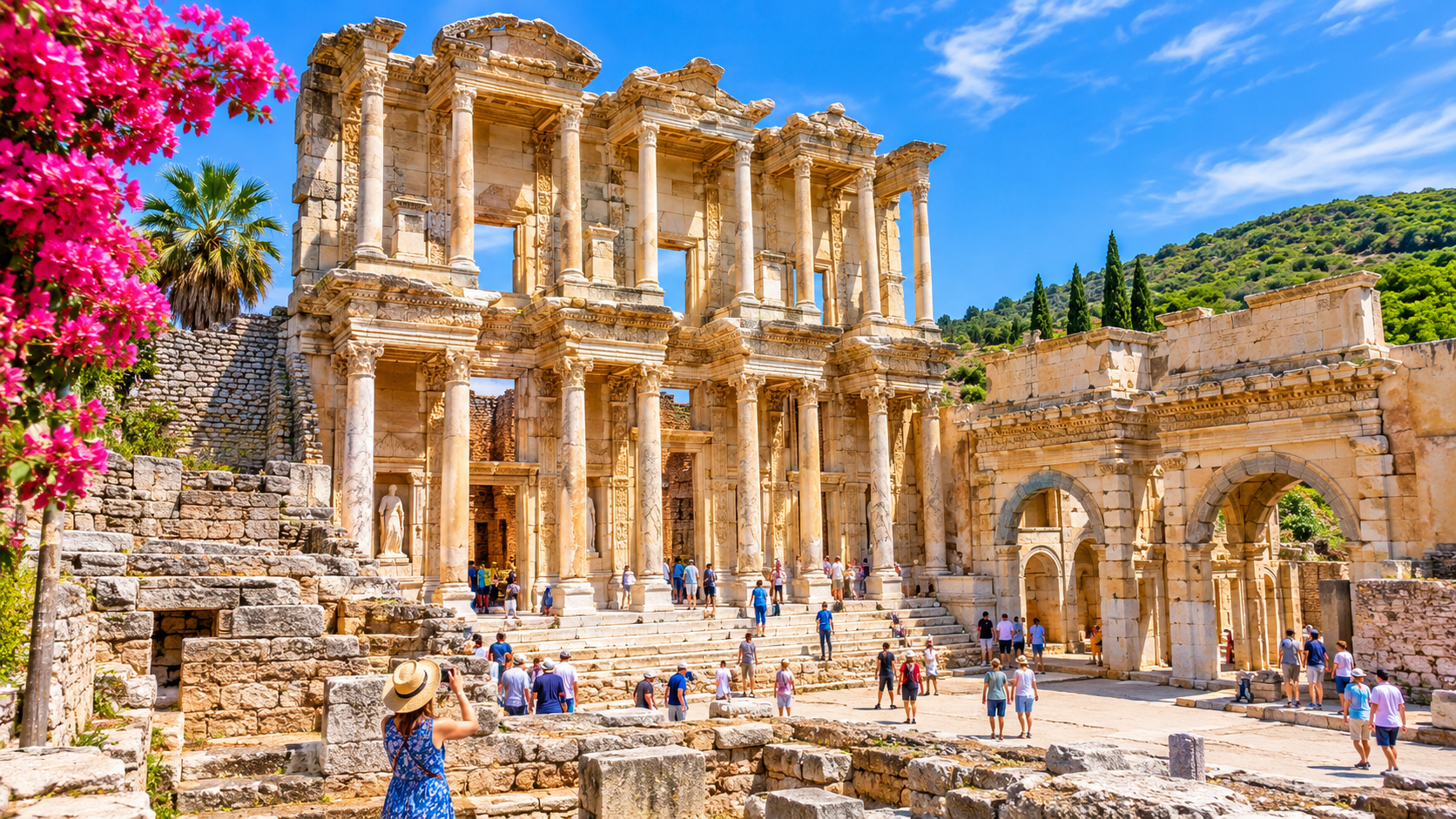
Some places draw visitors with their beaches, while others are known for their food or landscapes. Ephesus offers a different kind of experience. Here, you can spend a morning walking along ancient marble streets, looking at Roman buildings and discovering houses decorated with mosaics. History is not confined to a museum. It surrounds you.
Located near Selçuk in İzmir Province, western Turkey, Ephesus was once an important city of the ancient Greek and Roman worlds. Its position near major trade routes helped it grow into a centre of commerce, religion and public life. Much of the ancient city has survived, although some sections remain buried or damaged.
I would set aside a proper morning for the visit. The archaeological site covers a large area, and there is quite a bit of walking involved. Summer heat can make the experience tiring, particularly around midday, when the open streets offer little shade.
What I find particularly interesting about Ephesus is the contrast between its grand buildings and much smaller details. A magnificent theatre naturally attracts attention, but an old doorway or a faded mosaic can be just as fascinating. There is no need to rush from one monument to another.
Getting to Ephesus from Selçuk
Selçuk is the most convenient base for visiting Ephesus. It is close to the archaeological site, with cafés, restaurants and accommodation within easy reach. You can explore much of the town on foot before or after your visit.
Getting to the ruins is fairly straightforward. Local dolmuş minibuses leave from Selçuk Otogar and travel towards the Ephesus Lower Gate. Look for a vehicle marked Efes, or simply confirm the destination with the driver. Services are generally reported to run about every 30 minutes in quieter periods, with more frequent departures during the busier tourist season. The journey itself takes around 10 minutes, although you may need to wait for passengers before the minibus leaves.
The Lower Gate is roughly 3 kilometres from the centre of Selçuk. Walking there is possible, and the route is mostly flat. Still, I would not recommend doing it in the afternoon during summer. A taxi is a more comfortable alternative, especially for families or anyone carrying bags.
A useful route tip: Ephesus has two entrances, known as the Upper Gate and Lower Gate. Many visitors prefer to enter through the Upper Gate and walk downhill towards the Lower Gate. It is a convenient way to see the main attractions without climbing the entire route. Since the dolmuş generally serves the Lower Gate, arrange a taxi to the Upper Gate if you prefer to follow this direction. Check your return transport before setting off.
Curetes Street: Where the City Opens Up
Curetes Street gives you a real sense of how Ephesus was laid out. This ancient marble road connects several important buildings and was once an active part of everyday city life. People would have walked here for shopping, business and social visits.
The paving is uneven, and centuries of use have left their mark on the stones. Look down occasionally. Some sections still reveal decorative details that are easy to miss when you are concentrating on the larger structures.
The Fountain of Trajan and the Temple of Hadrian are among the notable sights along the route. Both deserve a closer look, particularly if you enjoy Roman architecture. Their surviving columns, carved surfaces and architectural features offer plenty to examine.
Imagine this street several centuries ago, filled with merchants, visitors and residents going about their daily routines. There would have been conversations, movement and the noise of a busy commercial centre. Today, the atmosphere is considerably quieter. Only the surrounding stonework remains to suggest how lively the area once was.
The Library of Celsus: The Building That Steals the Attention
The Library of Celsus is probably the most recognisable building in Ephesus. Its impressive two-storey façade, decorated columns and carved details make it one of the most photographed landmarks in the ancient city.
Constructed in the second century AD, the library was dedicated to Tiberius Julius Celsus Polemaeanus, a Roman senator and governor. It was built to house manuscripts, while Celsus himself was buried in a chamber beneath the structure. The building therefore served both a cultural and commemorative purpose.
Step back before approaching the entrance. From a distance, you can appreciate the symmetry of the façade and the arrangement of its columns and decorative niches. Move closer, and the smaller architectural details become much easier to see.
The building is often surrounded by visitors, particularly during the morning when guided groups arrive. An early visit may give you a little more room to appreciate it. Take a few photographs, certainly, but leave your camera aside for a moment too.
There is something special about seeing such a well-known monument in person. The photographs rarely capture quite the same feeling.
The Great Theatre: Imagine 25,000 People in One Place
Few structures at Ephesus communicate the scale of the ancient city quite like the Great Theatre. Built into a natural hillside, this enormous structure could accommodate approximately 25,000 spectators. It hosted performances, public meetings and other large gatherings.
The seating rises in broad semicircles around the stage. From higher up, you can see across the archaeological site and towards the ancient Harbour Road. The view helps explain why this location was such an important part of public life.
The theatre was more than a place for entertainment. Public events brought large numbers of people together, giving the building an important social and civic role. Standing among the rows of seats, you can begin to understand just how many people once gathered here.
Take your time climbing the steps. The stone surfaces are uneven, and some sections may become slippery when wet. Good walking shoes are particularly useful here.
Once you reach a higher level, pause for a moment. The surrounding landscape and the enormous sweep of the seating make a memorable combination.
Terrace Houses: A Look Inside Roman Family Life
The Terrace Houses offer a glimpse into a more private side of ancient Ephesus. These residences belonged to wealthy families and stood on the slopes near Curetes Street. Unlike the public monuments, they reveal details about domestic life.
Inside, the remains of colourful mosaics, painted walls and decorative floors are particularly impressive. Rooms were arranged around courtyards, and some houses had sophisticated underfloor heating systems. These were not ordinary homes by ancient standards.
Look closely at the wall paintings. Some feature mythological scenes, while others display decorative patterns and carefully arranged colours. The floors are equally interesting, with mosaics that have survived despite centuries of exposure and damage.
You begin to see another side of Roman society here. These rooms were once places where families ate, entertained guests and spent their everyday lives. The remains may be incomplete, but they still reveal a surprising amount about the people who lived in them.
The Terrace Houses require a separate ticket from the main archaeological site. I would allow around 30–40 minutes for this section, especially if you enjoy looking at architectural details rather than simply passing through.
More to Discover Beyond the Famous Monuments
Ephesus has plenty of smaller structures that deserve attention. The Odeon, for instance, was a much smaller venue than the Great Theatre. It was used for public meetings and performances, including musical events. Its compact design reflects the different ways people gathered in the ancient city.
Hercules Gate is another feature worth stopping beside. Its surviving columns carry carved reliefs associated with Hercules. The narrow passage between them once marked an important point along the street, giving visitors a sense of how movement through this part of Ephesus was organised.
Other remains appear along the route. You will come across fragments of bath complexes, old gates and public buildings, some more complete than others. They do not always receive much attention, particularly when large tour groups are moving between the main attractions.
Photography can be particularly enjoyable in these quieter corners. Look for the smaller details: an old staircase, a weathered column or sunlight falling across a marble surface. Against the surrounding green hills, even a broken section of ancient stonework can make an interesting composition.
Not every memorable view here comes from a famous monument.
A Short Trip to the House of the Virgin Mary
After exploring the ancient streets, you might consider visiting the House of the Virgin Mary on Mount Koressos. The small stone building is located several kilometres from Ephesus and is traditionally associated with the final years of Mary’s life.
According to Christian tradition, Mary spent her final days in this area after arriving in Ephesus with Saint John. The site has become an important destination for Christian pilgrims, although its historical association is based on religious tradition rather than conclusive archaeological evidence.
The surroundings feel quite different from the open archaeological site. Trees provide shade, and the small building is set within a peaceful landscape. Visitors can explore the prayer areas and spend some time in the quieter outdoor spaces.
You will need separate transport to reach the site. A taxi from Selçuk or an organised tour is generally the most practical choice. It can be combined with an Ephesus visit, but I would avoid trying to fit both into an already rushed schedule.
What to Eat in Selçuk After Your Visit
After several hours among the ruins, a relaxed lunch in Selçuk sounds particularly appealing. The town has small local restaurants and cafés where you can enjoy traditional Turkish food without the busy atmosphere of some major tourist centres.
Start with gözleme, a thin flatbread filled with ingredients such as cheese, spinach or potato. It is cooked on a hot griddle and usually served warm. Simple, freshly prepared and satisfying.
Köfte is another popular choice. These seasoned meatballs are often served with rice, salad or grilled vegetables. Lentil soup is also widely available and makes a comforting option, especially during cooler months.
For something lighter, try simit with a glass of Turkish tea. Covered in sesame seeds, this popular bread is sold by bakeries and street vendors throughout the country. It is an easy snack when you do not feel like sitting down for a full meal.
There is another place worth adding to your itinerary if you have enough time: the Ephesus Archaeological Museum in Selçuk. Its collection includes sculptures and objects discovered during excavations in Ephesus and the surrounding region. Seeing these artefacts after walking through the ruins can help put the city’s history into perspective.
Tickets, Opening Hours and Practical Advice
As of November 2026, the listed admission prices are €40 for the main Ephesus archaeological site and €15 for the Terrace Houses. The latter requires a separate ticket. Prices may change, so check the official Turkish Museums website before travelling.
Allow approximately two to three hours for the main archaeological route. That should give you enough time to see the major landmarks without having to hurry. Add another 30–40 minutes for the Terrace Houses, along with extra time for photographs or short breaks.
Opening hours depend on the season, and the Upper and Lower Gates may have different ticket-office closing arrangements. It is better to check the latest official schedule a day or two before your visit, particularly when travelling outside the summer season.
A few useful things to carry:
- Drinking water: Much of the archaeological site is exposed to direct sunlight, especially during summer.
- A hat and sunscreen: There is limited shade along several sections of the walking route.
- Comfortable walking shoes: Marble paving and old stone steps can be uneven.
- A charged phone or camera: There are plenty of opportunities for photographs, even away from the major monuments.
- Turkish lira or a bank card: Useful for transport, meals and small purchases in Selçuk.
One last suggestion: avoid arriving shortly before closing time. Ephesus is spread across a large area, and a hurried visit can mean missing some of its most interesting sections.
Give Ephesus a Proper Morning
Ephesus deserves more than a quick stop on a busy Turkey itinerary. Its famous library and Great Theatre are impressive, of course, but the smaller remains help bring the ancient city to life. The old streets, decorated houses and fragments of public buildings all contribute to the experience.
Start early, choose your entrance with care and leave enough time to explore Selçuk afterwards. The House of the Virgin Mary and the Ephesus Archaeological Museum are also worth considering if your schedule allows another half-day.
I particularly like the contrast between the scale of the monuments and the quiet details scattered throughout the site. A huge theatre can leave you speechless, but so can a small mosaic that has survived for centuries or the worn surface of a marble staircase.
By the time you leave, you will have seen much more than a collection of ancient ruins. You will have walked through the remains of a city that once played an important role in the ancient world. And that is what makes Ephesus such an interesting place to explore.
About Zoey
Zoey is a passionate global traveler and travel content creator dedicated to helping explorers navigate international destinations with smart planning, accurate budgets, and practical guides. Through detailed itineraries and destination insights, Zoey aims to make world travel accessible and stress-free everyone.


With your fantastic picture and description Ephesus and Selcuk seem to be very great places to visit, Zoey!