
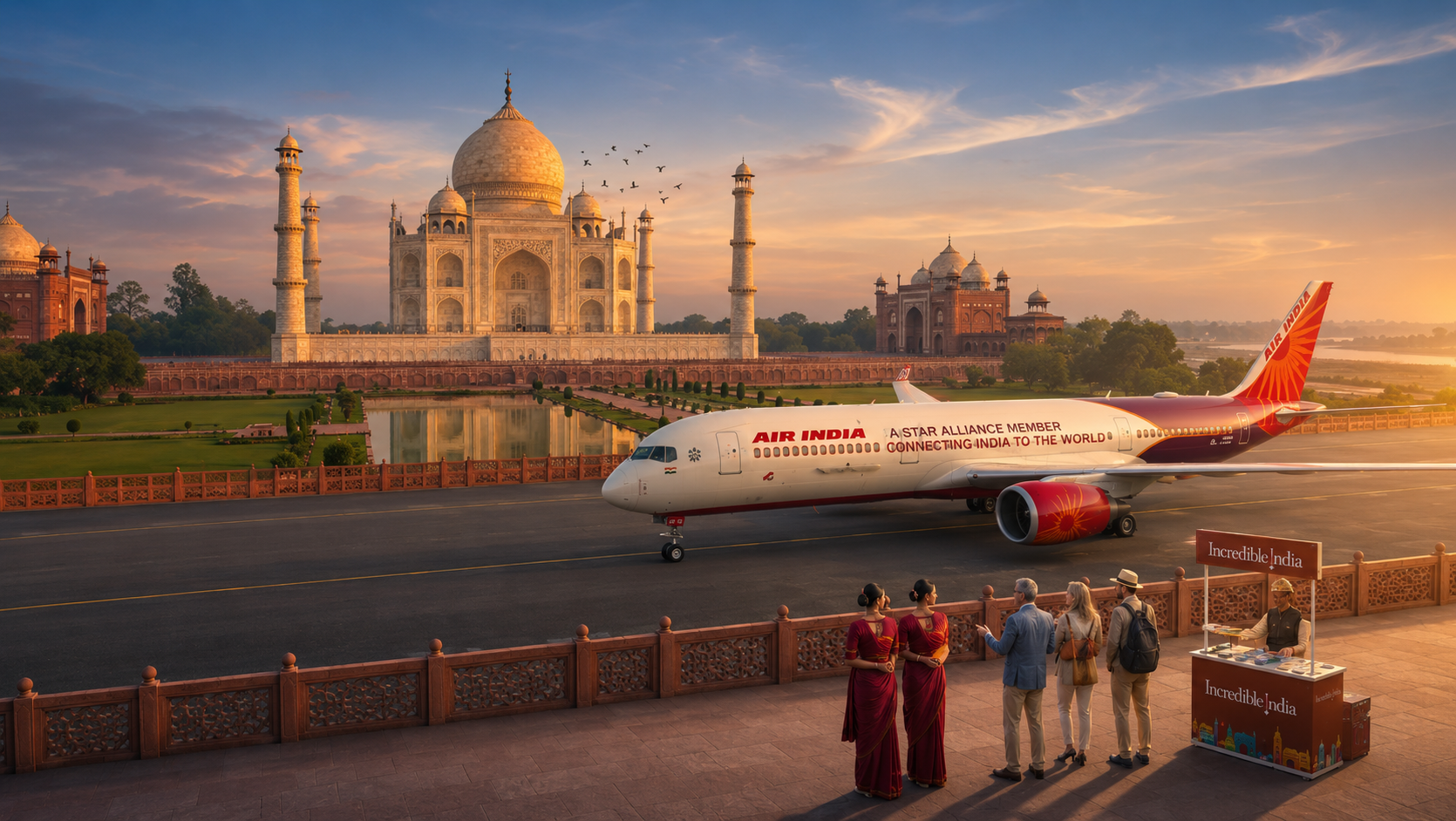

The Wings of “Incredible India”: How Air India and the Ministry of Tourism Are Reshaping Global Travel
Introduction: A New Dawn for India’s Global Narrative
There are few places on Earth that evoke the profound sensory tapestry, the breathtaking geographical diversity, and the civilizational depth of India. From the snow-capped, jagged peaks of the Himalayas to the sun-drenched, palm-fringed backwaters of Kerala; from the architectural marvels of the Golden Triangle to the spiritual tranquility of ancient monastic towns—India has always been a dream destination for the global wanderer. Yet, bridging the gap between a dream and a definitive travel itinerary requires more than just natural beauty; it demands seamless connectivity, world-class infrastructure, and a unified national narrative that welcomes the world with open arms.
In a landmark development that marks a historic turning point for the nation’s aviation and tourism sectors, Air India and the Ministry of Tourism (MoT), Government of India, have officially joined forces. Signed in New Delhi in the presence of Union Minister for Tourism and Culture Shri Gajendra Singh Shekhawat, a visionary Memorandum of Understanding (MoU) has been inked to jointly position India as a premier, must-visit global travel destination.
This high-impact partnership marries the unmatched global reach and modern fleet transformation of Air India with the legendary, globally recognized power of the Ministry’s Incredible India campaign. More than just a corporate handshake, this alliance represents a synchronized national mission: to rewrite India’s tourism story, elevate inbound visitor numbers, and firmly cement the country as a preeminent global aviation and transit hub.
The Anatomy of the Partnership: Pillars of Collaboration
At its core, the Air India-Ministry of Tourism MoU establishes a comprehensive, multi-layered framework designed to tackle every facet of the international traveler’s journey. Crafted to maximize synergy without financial encumbrances—structured as a non-commercial, non-binding, and non-exclusive strategic alliance—the partnership focuses on several core pillars:
- Global Marketing and Co-Branded Destination Storytelling:The collaboration will roll out aggressive, co-branded digital, social media, and offline marketing campaigns across international markets. By utilizing Air India’s digital channels, customer touchpoints, and state-of-the-art in-flight entertainment (IFE) systems, the Incredible India narrative will be beamed directly to millions of passengers cruising across the skies.
- Transforming India into a Global Transit Hub:With Air India dramatically expanding its international network—spanning major hubs across North America, Europe, the UK, Africa, Asia, and Australia—the partnership places heavy emphasis on stopover and transit tourism. Travelers flying between East and West will be incentivized and guided to experience India’s wonders during layovers through newly engineered stopover programs.
- Trade Engagement and Stakeholder Synergy:The alliance bridges the gap between policy and execution by actively engaging international tour operators, travel trade associations, and global media. Joint international roadshows, tourism exhibitions, and familiarization (FAM) trips will be deployed to showcase “New India” to travel agents worldwide.
- Elevating the Visitor Experience:From integrating state tourism boards into the promotional web to exploring loyalty program synergies (such as linking Air India’s Maharaja Club with cultural, heritage, and museum attractions across India), the partnership focuses on frictionless, deeply enriching ground and air experiences.
A Vision for “New India”: Voices from the Leadership
The signing ceremony in New Delhi brought together key architects of India’s economic and cultural resurgence. Their insights underline the profound gravity of this partnership.
Highlighting the cultural duty and ambassadorial role of the national carrier, Nipun Aggarwal, Chief Commercial Officer, Air India, articulated the vision behind the alliance:
“As the airline that proudly carries India in its name, Air India has a unique responsibility to showcase the country to the world and serve as an ambassador for ‘new India’ that is confident, vibrant, warm, and welcoming. As Air India expands its global network that already spans five continents and welcomes more visitors to India, this partnership with the Ministry of Tourism will help us to meaningfully put the spotlight on a nation that truly is uniquely remarkable.”
Echoing this sentiment, senior officials from the Ministry of Tourism emphasized that this collaboration leverages Air India’s network—which touches regions housing nearly 95% of the world’s population—to translate global curiosity into actualized travel bookings. With Air India modernizing its fleet, introducing cutting-edge cabin interiors, and expanding its footprint, the airline is no longer just a transport provider; it is the flying canvas of a resurgent nation.
The Strategic Imperative: Why Now?
To understand the true brilliance of this partnership, one must examine the macroeconomic and geopolitical shifts currently defining global tourism.
1. The Post-Pandemic Travel Renaissance and Shift in Preferences
Global travel habits have fundamentally transformed. Modern international travelers are no longer looking for cookie-cutter vacations; they are seeking experiential, immersive, and authentic journeys. They want wellness tourism (Ayurveda and yoga), culinary odysseys, spiritual awakenings, eco-tourism, and deep historical engagement. India, with its unmatched civilizational continuity, is uniquely positioned to cater to this shift. However, matching the intent to travel with easy accessibility has historically been a challenge. By streamlining transit and marketing, Air India and the Ministry are removing friction points for the foreign traveler.
2. The Aviation Renaissance of Air India
Under its ambitious transformation roadmap, Air India has broken out of its legacy constraints. Acquiring wide-body aircraft, rolling out revolutionary three-class configurations, ordering record-breaking numbers of planes, and expanding non-stop routes to key global gateways (such as New York, San Francisco, London, Frankfurt, Singapore, and beyond), Air India is building an aviation juggernaut. When an airline scales its international capacity aggressively, it creates an immediate need for inbound passenger demand. Conversely, a booming tourism ministry needs heavy airlift capacity. This MoU creates a symbiotic feedback loop: more flights drive more tourists, and higher tourism demand justifies deeper network expansion.
3. Capturing the Lucrative Transit Market
Geographically, India sits at the crossroads of the East and the West. Historically, global travelers flying between Europe/North America and Asia/Australia would transit through Middle Eastern or Southeast Asian hubs. The strategic push by Air India—centered around mega-hubs in Delhi and Mumbai—aims to recapture this traffic. By introducing lucrative stopover packages, international passengers can spend 24 to 72 hours exploring Agra’s Taj Mahal, Jaipur’s majestic forts, or Delhi’s culinary underbelly before catching their connecting flight. This transforms a routine transit into an unforgettable mini-vacation.
Exploring the Incredible Tapestry: What Awaits the Global Traveler
For international tourists reading global travel headlines or seeing vibrant digital campaigns powered by this new alliance, India offers a kaleidoscopic array of experiences that transcend traditional tourism.
1. The Heritage and Architectural Trail
India’s architectural heritage spans millennia. From the rock-cut wonders of Ellora and Ajanta caves in Maharashtra to the Dravidian temple marvels of Tamil Nadu (such as Thanjavur and Madurai); from the sun-kissed palaces of Rajasthan to the erotic poetry carved in stone at Khajuraho—the country is an open-air museum. The partnership will work closely with State Tourism Boards to bring these lesser-known historical corridors to the global forefront, ensuring tourists venture beyond the conventional paths.
2. Spiritual Awakening and Wellness Tourism
In an increasingly high-stress, hyper-digitalized world, travelers are desperately seeking inner peace and physical restoration. India is the undisputed birthplace of Yoga, Meditation, and Ayurveda. Whether it is meditating in the tranquil foothills of Rishikesh overlooking the holy Ganges, undergoing traditional Ayurvedic rejuvenation therapies in Kerala’s verdant green sanctuaries, or tracing the Buddhist circuit across Bihar and Uttar Pradesh, India offers soul-deep transformations.
3. Eco-Tourism, Wildlife, and Natural Splendor
Beyond monuments and ashrams, India is one of the world’s mega-biodiverse nations. It is home to the majestic Royal Bengal Tiger, the endangered Indian one-horned rhinoceros, and diverse ecosystems ranging from the mangrove forests of the Sundarbans to the high-altitude cold deserts of Ladakh. National parks like Jim Corbett, Bandhavgarh, Kanha, and Kaziranga offer world-class wildlife safaris. The new joint promotional campaigns will spotlight these natural wonders, attracting eco-conscious travelers from across the globe.
4. Culinary Tourism: A Symphony of Flavors
Indian cuisine is as diverse as its geography. Far beyond the generalized perceptions of curry, authentic Indian food changes dramatically every hundred kilometers—from the fiery coastal seafood of Goa and Kerala to the rich, aromatic gravies of Awadh (Lucknow), the comforting vegetarian thalis of Gujarat, and the robust flavors of Punjab. Culinary tourism is slated to be a major narrative driver in the co-branded storytelling initiatives.
The Digital Revolution and Seamless Passenger Journeys
A crucial component of the Air India-Ministry of Tourism MoU is the heavy reliance on digital integration and destination storytelling. In the era of algorithmic discovery, TikTok, Instagram Reels, and YouTube Shorts, modern travel decisions are often made in seconds based on visual storytelling.
- In-Flight Portals as Tourism Windows: Passengers boarding an Air India flight from New York, London, or Sydney will no longer just watch Hollywood blockbusters; they will be immersed in curated travel documentaries, state tourism features, and interactive destination guides right on their seatback screens.
- Loyalty Program Integration: By integrating the Maharaja Club loyalty ecosystem with cultural attractions, museums, and heritage sites, travelers are incentivized not just to fly with Air India, but to deeply engage with India’s cultural infrastructure. Earned points and exclusive privileges will unlock access to curated historical experiences, bridging the gap between frequent flyer benefits and cultural tourism.
- Global Digital Campaigns: Utilizing data-driven marketing, the Ministry and Air India will target specific demographic profiles across North America, Europe, and Asia-Pacific, showcasing customized itineraries ranging from luxury royal trails to backpacking adventure routes.
Economic Ripple Effects: Boosting Jobs and Local Economies
While the psychological and branding victories of this partnership are immense, the macroeconomic implications for India are profound. Tourism is one of the most powerful engines of inclusive economic growth. It is a massive employment multiplier, directly and indirectly supporting millions of jobs across:
- Hospitality: Hotels, resorts, homestays, and boutique heritage properties.
- Transport & Logistics: Cabs, tourist buses, heritage trains (like the Palace on Wheels), and domestic aviation.
- Artisans & Handicrafts: Local weavers, potters, brass workers, and traditional artisans whose livelihoods depend on souvenir and artifact sales.
- Gastronomy: Restaurants, street-food vendors, and organic farm-to-table initiatives.
By driving a surge in inbound international tourists—who typically spend significantly more per capita than domestic travelers—this partnership acts as a direct stimulus for local economies, empowering rural artisans, women-led tourism collectives, and small-scale entrepreneurs across India’s tier-2 and tier-3 cities.
Overcoming Challenges: The Path Forward
While the framework of the MoU is robust and visionary, turning these ambitious goals into reality will require meticulous execution and cross-sector coordination.
- Infrastructure and Last-Mile Connectivity: While international airports in Delhi, Mumbai, Bengaluru, and Hyderabad are world-class, last-mile connectivity to remote heritage sites, national parks, and cultural hubs must continually be upgraded. High-speed rail developments, better highway networks, and regional airport connectivity under schemes like UDAN will play a vital role.
- Visa Processes and Entry Friction: India has made tremendous strides by expanding its e-visa facility to cover 171 nations. Keeping visa processing times swift, transparent, and user-friendly will be crucial in converting a casual digital viewer into a confirmed traveler.
- Global Awareness and Safety Narratives: Proactive crisis communication, transparent traveler safety guidelines, and world-class customer service standards will ensure that visitors feel secure, valued, and eager to return.
Conclusion: The World is Invited to Experience the Magic
The partnership between Air India and the Ministry of Tourism is more than an institutional agreement; it is a declaration of confidence. It signals that India is ready to take its rightful place as a premier superpower in global tourism—not merely as a destination to be witnessed, but as an experience to be felt, absorbed, and remembered for a lifetime.
As Air India’s modern aircraft slice through international skies, carrying the spirit of Incredible India to every corner of the globe, they carry more than passengers. They carry the warmth of Indian hospitality, the richness of its heritage, the rhythm of its diversity, and the promise of a wondrous journey.
For the global traveler holding a passport and searching for a destination that awakens the soul, the message is clearer and more inviting than ever before: Your journey into the extraordinary begins here. Welcome to India.
“When I first read about this update, it instantly reminded me of the absolute headache of wrestling with foreign transport apps on past trips—and honestly, this feature is a total game-changer.”
Have you ever pushed through travel anxieties or flight disruptions just to take a dream trip? Drop a comment and tell me about your most unforgettable travel adventure!
About the Author: Zoey
Zoey is a passionate travel writer and researcher at VentureWibe, dedicated to bringing readers the latest global travel news, inspiring destination guides, and tourism trends from around the world. With a keen eye for uncovering unique travel stories, Zoey helps explorers stay informed and prepared for their next adventures.
- Expertise: Global Tourism, Destination Research, and Travel Insights

Discover more from venture
Subscribe to get the latest posts sent to your email.


I very delighted to find this site on bing, just what I was searching for : D besides saved to favorites.