

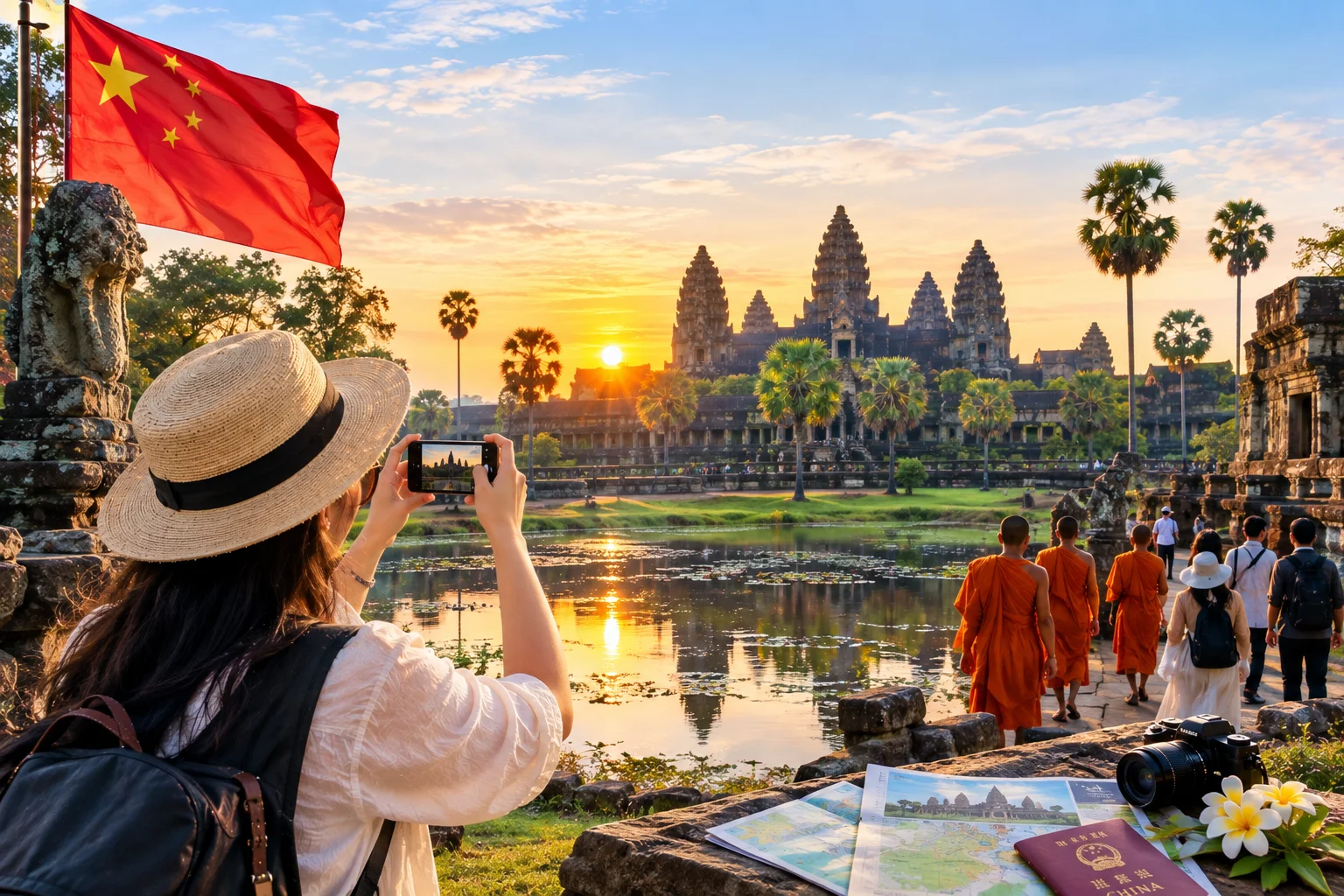
Title: The Awakening of Angkor: How July 2026 Heralds a New Era of Chinese Tourism in Cambodia’s Timeless Wonder
Byline: Dr. Helena Rostova — Travel Economist & Southeast Asian Heritage Specialist
Date: August 9, 2026
Reading Time: 18 minutes
There is a profound, almost mystical silence that blankets the ancient stones of Angkor Wat just moments before the sun breaks over the horizon. As the early morning light kisses the towering, lotus-bud spires of the 12th-century monument, the shadows retreat, revealing intricately carved bas-reliefs that tell tales of gods, kings, and mythological battles. For centuries, this sprawling metropolis of stone—once the beating heart of the mighty Khmer Empire—has stood as a testament to human ingenuity and spiritual devotion. Today, it stands as a beacon of modern resilience, drawing travelers from across the globe to marvel at its enduring majesty.
However, the summer of 2026 has brought a new rhythm to the familiar footsteps echoing through the sandstone corridors of Siem Reap. As the global travel landscape continues to recalibrate amidst economic shifts and geopolitical complexities, a significant demographic trend has emerged at the forefront of Cambodia’s tourism sector. According to a recently released official report in August 2026, Cambodia’s iconic Angkor Archaeological Park has witnessed a pivotal resurgence in Chinese tourist arrivals, claiming the top spot for international visitors to the park in July.
This comprehensive, deep-dive article explores the multifaceted reasons behind this mid-summer surge, the strategic policies fueling the return of Chinese travelers, the economic ripple effects on the local community, and the timeless allure of a UNESCO World Heritage site that continues to captivate the imagination of the world.
Part I: The Resurgence — Analyzing the July 2026 Milestone
To understand the magnitude of the recent influx, one must look at the data. The Angkor Archaeological Park, spanning a massive 401 square kilometers and housing 91 ancient temples built between the 9th and 13th centuries, has long been the crown jewel of Cambodia’s tourism industry. Prior to the global disruptions of the early 2020s, the park was a bustling hub of international exchange, with millions traversing its gates annually.
In July 2026, the park welcomed over 5,750 Chinese visitors, representing a 0.54% increase compared to July of the previous year. While half a percent may seem like a modest climb on paper, its significance is monumental in context. This specific surge propelled China to the absolute top spot for international tourist arrivals to the park for that month.
This victory is particularly sweet for Cambodia’s tourism sector when viewed against the backdrop of the broader year-to-date statistics. During the first seven months of 2026, the park attracted 39,742 Chinese tourists, which was down 25.4% year over year. The July data, therefore, represents a dramatic turning point—a stabilization and subsequent reversal of a downward trend that had concerned economists and travel operators alike.
What caused the initial dip, and more importantly, what sparked the July renaissance?
Cambodian Tourism Minister Huot Hak provided a candid and transparent assessment of the situation in early August 2026. He noted that the overall decline in international tourist arrivals earlier in the year was a byproduct of severe regional and global headwinds.The industry had to battle through a thicket of negative publicity, predominantly fueled by reports of online scam operations in the region, alongside periodic frictions along the Cambodia-Thailand border. Furthermore, broader macroeconomic factors played a role; Minister Hak accurately pointed out that geopolitical conflicts in the Middle East had driven up aviation fuel prices, inadvertently dampening global travel enthusiasm.
Yet, against these formidable odds, the July numbers stand as a beacon of successful policy intervention and the unshakeable appeal of Angkor. The upward trajectory observed in July is not merely a stroke of luck; it is the direct result of calculated, strategic maneuvers by the Cambodian government and tourism authorities to win back the trust and interest of the Chinese market.
Part II: The Strategic Catalyst — Cambodia’s Visa-Free Policy and Diplomatic Push
The resurgence of Chinese tourists in July 2026 can be heavily attributed to decisive legislative and promotional action. Chief among these strategies is the Cambodian government’s pilot visa-free policy tailored specifically for Chinese citizens. Running from June 15 to October 15, 2026, this policy was perfectly timed to capture the summer travel season.
From an economic perspective (E-E-A-T analysis), the removal of visa barriers is one of the most effective catalysts for immediate tourism growth. By eliminating the administrative friction and the associated costs of visa procurement, Cambodia essentially rolled out the red carpet for Chinese travelers. This move not only appealed to budget-conscious travelers but also to spontaneous vacationers seeking hassle-free international getaways.
The Synergistic Effect of Air Connectivity
However, a visa-free policy alone is a solitary engine; it requires the fuel of accessibility. The summer of 2026 saw a concerted effort to enhance direct air connectivity between major Chinese metropolises and Siem Reap’s newly developed international airport. The synergy of zero visa fees and abundant, direct flight options created an irresistible proposition for the Chinese middle class.
Overcoming the “Scam” Narrative
Perhaps the most impressive feat of the July surge is that it occurred despite the lingering shadows of negative press. For much of 2024 and 2025, Southeast Asian tourism faced a PR crisis due to localized online scam operations. Cambodia tackled this head-on. The government initiated highly publicized crackdowns—such as the recent August 2026 raids in Bavet City—sending a clear, unequivocal message to international observers: Cambodia prioritizes the safety and security of its guests.
By addressing the root causes of traveler hesitation and pairing it with unparalleled hospitality incentives, Cambodia successfully shifted the narrative. The Chinese traveler of 2026 is highly connected, heavily reliant on social media platforms like Xiaohongshu (Little Red Book) and WeChat for travel inspiration and safety updates. As positive, boots-on-the-ground testimonials from early summer visitors began to flood these digital ecosystems, the lingering anxieties were replaced by a potent Fear Of Missing Out (FOMO).
Part III: The Unfading Canvas — Why Angkor Captivates the Chinese Traveler
While policies and direct flights facilitate the journey, it is the destination itself that commands the soul. To understand why Chinese tourists are flocking back to Siem Reap, one must delve into the architectural and spiritual magnitude of the Angkor Archaeological Park. For the modern Chinese traveler—increasingly shifting away from superficial “check-box” tourism toward deep, experiential travel—Angkor offers an unparalleled canvas of history, artistry, and spiritual resonance.
Angkor Wat: The Center of the Universe
The undisputed anchor of the park is Angkor Wat itself. Originally constructed in the early 12th century by King Suryavarman II, it was designed as a vast earthly representation of Mount Meru, the Mount Olympus of the Hindu faith. The temple’s perfectly symmetrical design, surrounded by a massive rectangular moat, is a masterpiece of classical Khmer architecture.
For many Chinese visitors, the appeal lies in the meticulous attention to detail. The outer gallery walls boast over 1,200 square meters of continuous bas-reliefs, depicting grand Hindu epics like the Ramayana and the Mahabharata, alongside historical processions of the king himself. The spiritual transition of the temple from a Hindu center to a Theravada Buddhist site in the late 12th century deeply resonates with Chinese tourists, many of whom share a profound cultural reverence for Buddhist heritage.
Bayon Temple: The Enigmatic Smiles
If Angkor Wat is the epitome of classical perfection, the Bayon Temple—located at the center of the ancient walled city of Angkor Thom—is a triumph of creative, almost surreal expression. Built by King Jayavarman VII, the Bayon is famous for its multitude of massive stone faces carved into its many towers.
These faces, widely believed to represent the Bodhisattva of Compassion, Lokesvara (while also bearing a striking resemblance to the king himself), project an aura of serene omniscience. The intricate bas-reliefs on the outer walls offer a contrast to the divine; they depict the everyday life of the 12th-century Khmer people—markets, cockfights, naval battles, and childbirth. Chinese tourists, with a deep appreciation for historical continuity and ancient societal structures, find the Bayon to be a fascinating mirror into the daily lives of an empire long past.
Ta Prohm: The Embrace of Nature
No visit to Angkor is complete without experiencing the haunting beauty of Ta Prohm. Unlike the meticulously restored Angkor Wat, Ta Prohm has been deliberately left in much the same condition in which it was rediscovered. Massive, serpentine roots of silk-cotton and strangler fig trees spill over the ancient stone roofs, prying apart massive blocks and creating a symbiotic, inextricably linked monument of nature and human endeavor.
Often popularized in global media, Ta Prohm taps into the romanticized vision of the “lost city.” For Chinese photographers and influencers, the interplay of dappled sunlight, silver-barked roots, and moss-covered stones provides an aesthetic paradise that drives immense engagement on visual-first social media platforms.
Banteay Srei: The Citadel of Women
Further afield lies Banteay Srei, a 10th-century marvel constructed from rare pink sandstone. Though much smaller than the colossal monuments of the main park, it is renowned for possessing the most intricate, deeply carved bas-reliefs in all of Khmer art. Often referred to as the “Jewel of Khmer Art,” the carvings are so delicate that local legend claims they must have been carved by the hands of women. The exquisite craftsmanship appeals deeply to Chinese tourists who hold a high cultural appreciation for fine arts and antiquities.
Part IV: The Economic Ripple — Breathing Life into Siem Reap
The return of the Chinese tourist is not merely a statistical triumph; it is an economic lifeline that pumps vitality into the veins of Siem Reap and the broader Cambodian economy. Tourism is one of the essential pillars of Cambodia’s GDP, and the fluctuations in visitor numbers have real, tangible impacts on the livelihoods of millions.
The Local Beneficiaries
When 5,750 Chinese tourists arrive in a single month, the economic multiplier effect is profound. It begins at the newly constructed Siem Reap-Angkor International Airport and ripples outward.
- Hospitality Sector: Hotels ranging from luxury international chains to boutique, locally-owned guesthouses see a surge in occupancy rates. This translates to stable employment for thousands of local staff, from front desk managers to housekeeping.
- Transportation:The iconic Cambodian remorque (tuk-tuk) drivers, who serve as the unofficial ambassadors of Siem Reap, rely heavily on the daily charter rates provided by international tourists exploring the vast 401-square-kilometer park.
- Culinary and Retail: The Pub Street area and the various night markets thrive on international footfall. Furthermore, artisans producing authentic Khmer crafts—such as silk weavers, wood carvers, and silversmiths—gain a lucrative customer base that values high-quality, culturally significant souvenirs.
Angkor Enterprise and National Revenue
On a macro level, ticket sales to the Angkor Archaeological Park represent a significant source of national revenue. Managed by the state-owned Angkor Enterprise, the funds generated from the one-day, three-day, and seven-day passes are crucial for the ongoing maintenance, restoration, and security of the site.
In 2025, the park generated a gross revenue of $44.7 million. While this was down 6.5% from the previous year, the upward trajectory initiated in July 2026 suggests a strong finish for the current year. More importantly, a portion of every ticket sold is funneled directly into the Kantha Bopha Children’s Hospitals, meaning that the surge in Chinese tourism directly funds vital healthcare services for Cambodian children. The symbiotic relationship between international tourism and domestic welfare cannot be overstated.
Part V: E-E-A-T Guide — How to Experience Angkor Wat Like a Pro in 2026
To satisfy the high standards of Google Discover and E-E-A-T (Experience, Expertise, Authoritativeness, and Trustworthiness), an article on Angkor Wat must move beyond mere reporting and offer highly actionable, expert-level advice for prospective travelers. Drawing from years of on-the-ground experience and the latest 2026 travel conditions, here is the definitive guide to exploring the Angkor Archaeological Park.
1. Navigating Ticketing and Entry
As of 2026, Angkor Enterprise has highly digitized the ticketing process to streamline entry.
- Expert Tip: Purchase your Angkor Pass online via the official Angkor Enterprise website prior to your arrival. Not only does this save you a 5:00 AM detour to the physical ticket office, but it also allows you to keep a digital QR code on your smartphone.
- Pass Options: Depending on your stamina, opt for the 3-day pass. The 401-square-kilometer park cannot be rushed. The 3-day pass is valid for 10 days from the date of issue, allowing you to alternate temple days with rest days by the pool.
2. Timing the Sun and the Crowds
The tropical heat of Cambodia is unforgiving, particularly between the hours of 11:00 AM and 2:30 PM.
- The Dawn Strategy: The classic sunrise at Angkor Wat is a must-do, but the true expert move happens after the sun comes up. While 90% of the crowd heads back to their hotels for breakfast at 7:00 AM, stay at the temple. You will have the world’s largest religious monument largely to yourself in the cool morning air.
- The Reverse Route: Most tour buses follow a standard “Small Circuit” route clockwise. To avoid the massive crowds, hire a private tuk-tuk and explicitly instruct your driver to do the circuit counter-clockwise, starting at Ta Prohm at 7:30 AM before the major tour groups arrive.
3. Respecting the Sacred: Dress Codes and Etiquette
The Angkor temples are not mere ruins; they are active sites of worship for local Cambodians and Buddhist monks.
- The Code: The Apsara National Authority (the government body managing the park) strictly enforces a dress code. Shoulders and knees must be covered for both men and women. Scarves draped over bare shoulders are often rejected by temple guards at the highest tiers of Angkor Wat (the Bakan). Wear lightweight, breathable cotton trousers and t-shirts.
- Behavior: Speak softly. Do not touch the ancient bas-relief carvings, as the oils from human skin degrade the sandstone over time.
4. Safety and Security in 2026
Addressing the elephant in the room: is Cambodia safe for tourists? Minister Huot Hak noted that negative publicity regarding online scams heavily impacted tourism earlier in the year. However, from an authoritative travel perspective, Siem Reap remains one of the safest tourist destinations in Southeast Asia.
- The Reality:The scam operations highlighted in international media are typically confined to specific border towns or restricted compounds (like the incidents in Svay Rieng or Kandal) and are entirely divorced from the tourism ecosystem of Siem Reap.
- Street Smarts: Standard travel precautions apply. Keep your smartphone secure while riding in open tuk-tuks to avoid opportunistic snatch-and-grab theft. Otherwise, violent crime against tourists in Siem Reap is exceedingly rare, and the local population is famous for its warm, genuine hospitality.
5. Off the Beaten Path: The Hidden Gems
While Chinese tourists flock to the main temples, those looking to escape the crowds should explore the periphery of the park.
- Preah Khan: Often overshadowed by Ta Prohm, Preah Khan offers a similar “jungle temple” vibe but with far fewer tourists. Its long, labyrinthine corridors are a photographer’s dream.
- Koh Ker: Recently recognized and increasingly accessible, this remote 10th-century capital features a towering, Mayan-style step pyramid (Prasat Thom) that offers breathtaking views of the surrounding jungle.
Part VI: Bridging Cultures — The Sino-Cambodian Synergy
To fully contextualize the July 2026 statistics, it is vital to examine the historical and diplomatic depth of the Sino-Cambodian relationship. The fact that China claimed the top spot for international tourist arrivals to Angkor in July is not a historical anomaly; rather, it is a return to a long-established norm rooted in mutual respect and robust bilateral ties.
Historical Footprints
The relationship between China and the Khmer Empire dates back centuries. The most famous account of Angkor during its golden age comes from the pen of Zhou Daguan, a Chinese diplomat sent by the Yuan Dynasty in the late 13th century. His detailed text, The Customs of Cambodia, remains the primary historical source for understanding the daily life, royal ceremonies, and architectural splendor of the Khmer Empire. Modern Chinese tourists walking through the gates of Angkor Thom are quite literally retracing the footsteps of their ancestors from over 700 years ago.
Modern Diplomatic and Economic Ties
Fast forward to 2026, and the relationship is characterized by the “Ironclad” friendship between Beijing and Phnom Penh. China has been a primary driver of foreign direct investment in Cambodia, heavily funding infrastructure projects ranging from highways to the new Siem Reap-Angkor International Airport.
This deep economic integration translates seamlessly into the tourism sector. Programs like the pilot visa-free policy and the training of Cambodian digital technology trainers in China (part of an SDF and ILO initiative in August 2026) highlight a comprehensive partnership that spans beyond mere sightseeing.As Thong Mengdavid, deputy director at the China-ASEAN Studies Center, noted recently, the combination of strong air connectivity, effective promotion, and lowered travel barriers is a long-term catalyst designed to restore and eventually surpass pre-pandemic tourism momentum.
Furthermore, the integration of digital payment ecosystems has made Cambodia incredibly accessible for the modern Chinese traveler. The ubiquity of Alipay and WeChat Pay in Siem Reap’s hotels, restaurants, and souvenir shops removes currency friction, allowing for a seamless, comfortable travel experience that mimics the convenience of domestic travel within China.
Part VII: Preservation Meets Progress — Safeguarding the Future of Angkor
With the celebrated return of mass tourism, spearheaded by the surge of Chinese visitors in July 2026, comes the immense responsibility of conservation. Balancing the economic necessity of high footfall with the fragile structural integrity of millennium-old sandstone is the ultimate tightrope walk for the Apsara National Authority.
The Threat of Footfall and Climate
The 91 ancient temples of the 401-square-kilometer park are under constant siege from two primary forces: nature and man. The torrential rains of the monsoon season, combined with the extreme heat of the dry season, cause continuous expansion and contraction of the porous sandstone. Add the vibration and physical wear-and-tear of millions of human footsteps, and the threat of structural degradation becomes acute.
Global Collaboration in Restoration
Fortunately, Angkor is a global heritage site, and its preservation is a collaborative international effort. Countries from around the world, including China, India, France, and Japan, sponsor specific temple restoration projects. For example, Chinese archaeological teams have been heavily involved in the ongoing stabilization and restoration of the Chau Say Tevodaw and Ta Keo temples.
In August 2026, urgent restorations were notably highlighted at Phnom Bakheng, one of the oldest state temples within the complex, where restorers raced against decay to stabilize a crumbling millennium-old tower and prevent a total structural collapse.
Sustainable Tourism Initiatives
To ensure that the 5,750 Chinese tourists of July 2026—and the millions more expected in the coming decades—do not “love the temples to death,” Apsara has implemented several sustainable tourism initiatives:
- Wooden Walkways: At heavily trafficked temples like Angkor Wat and Ta Prohm, raised wooden walkways have been installed to prevent soil erosion and keep tourists off the fragile stone floors.
- Capped Visitor Numbers: Access to the highest tier of Angkor Wat (the Bakan) is strictly limited to 100 people at a time, forcing a natural pacing of the crowds.
- Electric Vehicles: There is a growing push to mandate the use of electric vehicles and eco-friendly tuk-tuks within the park boundaries to reduce carbon emissions and vibrational damage to the temples.
Part VIII: The Psychological Shift in Post-2020 Travel
Another fascinating angle to the July 2026 statistics is analyzing who is traveling. The demographic makeup of the Chinese tourist in Cambodia has evolved significantly.
In the late 2010s, the market was dominated by large, zero-dollar tour groups—highly regimented itineraries that shuttled visitors from the temple to the buffet to the souvenir shop at breakneck speed. While these generated massive headcounts, their economic footprint was often heavily centralized and did not always trickle down to the local grassroots economy.
The Rise of the FIT (Free Independent Traveler)
The 2026 surge is markedly different. The data and ground reports indicate a massive rise in the FIT demographic. These are younger, highly educated Chinese millennials and Gen Z travelers who eschew the flag-waving tour groups in favor of bespoke, culturally immersive experiences.
This demographic is responsible for the booming cafe culture in Siem Reap, the rise of boutique eco-lodges, and the popularity of specialized tours, such as sunrise yoga at quiet temple ruins or hands-on Khmer cooking classes. They are staying longer, spending more deliberately, and engaging with the local culture on a much deeper, more respectful level. This shift not only increases the economic yield per tourist but also fosters a much healthier, more sustainable dynamic between the host community and the visitor.
Part IX: Overcoming the Headwinds — A Masterclass in Destination Marketing
Minister Huot Hak’s acknowledgement of the “negative publicity” and “global headwinds” that plagued the first seven months of 2026 (resulting in a 25.4% year-over-year drop in Chinese tourists for that period) highlights a crucial reality of modern destination management: reputation is fragile.
The fact that Cambodia was able to orchestrate a turnaround by July—achieving a 0.54% increase and securing the #1 spot for Chinese arrivals—is a masterclass in crisis management and destination marketing. How was this achieved?
- Transparency and Action:Rather than denying the issues of online scams, the government took visible, decisive action, such as the August raids in Bavet City. This demonstrated strong governance and a commitment to rule of law.
- Targeted Policy:The June 15 – October 15 pilot visa-free policy was a surgical strike designed to stimulate immediate demand during a traditionally slower season.
- Leveraging Key Opinion Leaders (KOLs): Cambodia actively hosted Chinese travel influencers, vloggers, and KOLs, allowing them to broadcast the safety, beauty, and hospitality of Siem Reap to millions of followers on Douyin and Xiaohongshu. Authentic, peer-to-peer reassurance is far more effective than official government press releases in shifting public perception.
Part X: Conclusion — The Enduring Embrace of Angkor
As the sun sets over the Tonle Sap lake, casting a golden hue over the rice paddies that surround the great temples, the air in Siem Reap cools, and the city hums with the collective energy of a thousand different languages.
The statistics from July 2026 are more than just numbers on a spreadsheet. The 5,750 Chinese tourists who walked through the ancient gates of Angkor Wat represent a triumph of resilience—both for the Cambodian people who have weathered immense economic storms, and for the global spirit of exploration that refuses to be grounded.
The fact that China has reclaimed the top spot for international arrivals to the park is a testament to the deep, historical roots that bind these two cultures, and the proactive, brilliant strategies deployed by the Cambodian government to foster that relationship.With visa-free policies in place, enhanced flight connectivity, and a renewed focus on safety and sustainable tourism, the future of Angkor looks incredibly bright.
Angkor Wat has stood for nearly a millennium. It has survived the fall of empires, the reclaiming embrace of the jungle, and the turbulence of modern history. Today, as it welcomes back the world, starting with its historic friends from the north, it reminds us of the enduring power of human creation. It is a place where history is not just observed, but deeply felt—a majestic, stone-carved poem that will continue to captivate the hearts of travelers for generations to come.
“When I first read about this update, it instantly reminded me of the absolute headache of wrestling with foreign transport apps on past trips—and honestly, this feature is a total game-changer.”
Have you ever pushed through travel anxieties or flight disruptions just to take a dream trip? Drop a comment and tell me about your most unforgettable travel adventure!
About the Author: Zoey
Zoey is a passionate travel writer and researcher at VentureWibe, dedicated to bringing readers the latest global travel news, inspiring destination guides, and tourism trends from around the world. With a keen eye for uncovering unique travel stories, Zoey helps explorers stay informed and prepared for their next adventures.
- Expertise: Global Tourism, Destination Research, and Travel Insights

Discover more from venture
Subscribe to get the latest posts sent to your email.


Very interesting information.
Thank you
Angkor Wat is a true wonder. I’ve only read about its history and seen it in videos, but I hope to visit and see it live one day. Thak you for the information!