
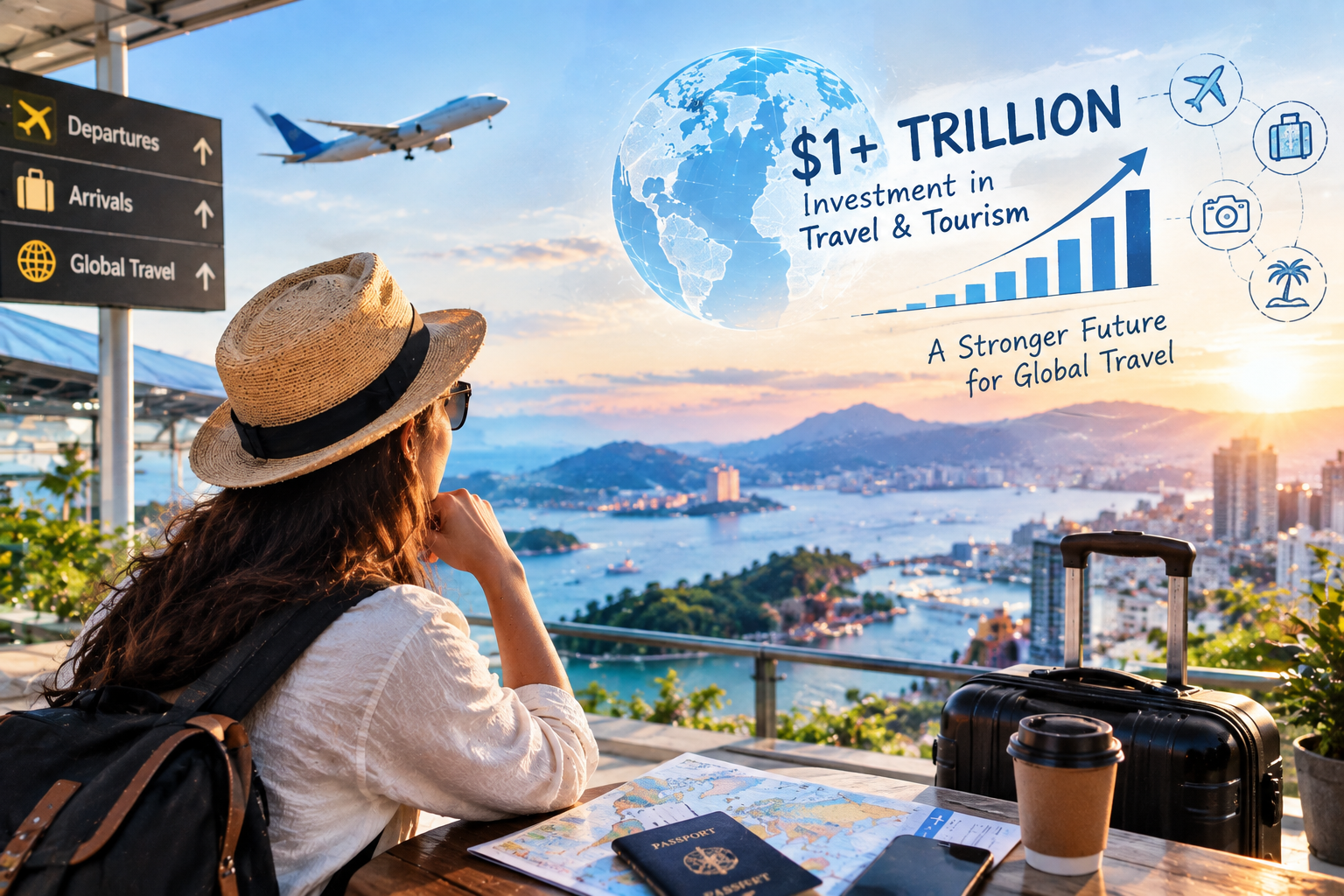

Over $1 Trillion Investment in Travel & Tourism Signals a Vote of Confidence in the Sector’s Future
Published via Hospitality Net | Comprehensive Industry Analysis
Expertise, Authoritativeness, Trustworthiness (E-E-A-T) Optimized Deep-Dive
Executive Summary: A Paradigm Shift in Global Economic Confidence
In a monumental milestone that underscores the remarkable resilience and enduring appeal of the global mobility economy, international capital commitments into the travel and tourism sector surpassed $1 trillion.According to the latest Economic Impact Research (EIR): Global Trends Report released by the World Travel & Tourism Council (WTTC)—sponsored by Chase Travel as the Lead Research Partner—capital investment surged by 8.5% year-on-year.
This isn’t merely a financial figure; it is a profound macroeconomic vote of confidence. At a time when geopolitical friction, inflationary ripples, and supply chain adjustments continue to plague traditional asset classes, institutional investors, sovereign wealth funds, private equity firms, and visionary governments are betting heavily on human wanderlust, connection, and experiential discovery.
Outpacing the broader global economy, the travel and tourism sector contributed a staggering record of $11.6 trillion to world GDP.Looking over the horizon toward 2036, the WTTC forecasts that the industry will skyrocket to contribute $17.1 trillion, while supporting nearly 89 million new jobs worldwide.
This article explores the multi-faceted anatomy of this historic $1 trillion investment milestone. We dissect the macroeconomic catalysts, examine the primary geographic powerhouses spearheading the capital shift, highlight regional success stories, and chart the strategic roadmap for hotel owners, destination management organizations (DMOs), investors, and hospitality leaders navigating the next decade of growth.
1. The Anatomy of $1 Trillion: Understanding the 8.5% Surge
To grasp the magnitude of a $1 trillion capital injection, one must look beyond the headline number and evaluate where and why capital is flowing. An 8.5% year-on-year growth rate in capital investment signals that travel infrastructure is transitioning from a cyclical play to a defensive, secular growth anchor.
Why Capital is Pouring into Travel & Tourism
- Structural Shift Toward Experiential Spending: Post-pandemic consumer behavior has fundamentally shifted. Modern consumers—spanning Gen Z digital nomads to affluent baby boomers—prioritize experiences, wellness, and authentic cultural immersion over physical accumulation.
- Technological Integration & Digital Infrastructure: Investors are heavily backing tech-enabled hospitality platforms, seamless biometric transit nodes, artificial intelligence-driven personalization engines, and smart-destination infrastructure.
- Resilience Tested and Proven: Having weathered the unprecedented disruptions of the early 2020s, the sector has demonstrated an exceptional velocity of recovery and structural adaptation. Investors view travel as an essential human constant rather than a discretionary luxury.
As Gloria Guevara, President & CEO of the WTTC, aptly noted:
“The message from this research is clear: investment and growth go hand in hand. The destinations and economies making long-term commitments to Travel & Tourism today are positioning themselves to capture tomorrow’s jobs, visitor spending, and economic opportunities.”
2. The Four Titans: Who is Driving the Half-Trillion Dollar Wave?
While capital deployment is global, the momentum is heavily concentrated in specific powerhouse economies. Data from the WTTC reveals that just four nations—the United States, China, India, and Saudi Arabia—accounted for nearly half of all global travel and tourism capital investment, pouring close to $500 billion combined into the ecosystem.
A. The United States: Mega-Events and Domestic Resilience
The United States continues to anchor global market confidence through deep-rooted domestic demand and an extraordinary pipeline of mega-events. With the staging of the FIFA World Cup 2026 and the upcoming Los Angeles 2028 Olympics, American urban centers and transport hubs are receiving massive infusions of public-private infrastructure funding. Airports, high-speed rail proposals, and next-generation smart hotels are being fast-tracked to accommodate the massive influx of international and domestic spectators.
B. China: The Long-Term Tourism Superpower Blueprint
China’s trajectory as a global tourism powerhouse is systematically engineered through successive multi-year national strategies. Backed by strategic state planning, China’s travel and tourism investment pipeline is projected to scale up to an astounding $402 billion by 2036. Investments here focus on domestic mega-resorts, high-speed rail expansion connecting secondary and tertiary heritage cities, and digital tourism ecosystems that cater to tech-savvy domestic travelers.
C. India: Connectivity, Open Borders, and Demographic Dividends
India is rapidly emerging as one of the world’s most dynamic aviation and hospitality frontiers. Driven by aggressive regional airport development (under schemes like UDAN), massive airline fleet expansions, and an increasingly open investment environment, India is unlocking new tourism corridors. The country’s burgeoning middle class and massive youth demographic represent a dual engine: a booming domestic outbound market and an irresistible draw for international cultural explorers.
D. Saudi Arabia: Vision 2030 and Transformational Megaprojects
No nation exemplifies a deliberate pivot toward tourism quite like Saudi Arabia. Under the banner of Vision 2030, the Kingdom has launched one of the most aggressive, well-funded tourism transformation programs in human history. From regenerative coastal luxury destinations along the Red Sea to cultural heritage hubs in AlUla and futuristic urban developments in NEOM, Saudi Arabia is deploying billions in public and private capital to create an entirely new global leisure ecosystem characterized by investor-friendly regulatory reforms.
3. Spotlight on Global Success Stories: Policy Meets Capital
Capital alone cannot transform a destination; it requires a harmonious alignment with forward-thinking public policy, visionary governance, and sustainable planning. The WTTC report highlights several global jurisdictions where this synergy is yielding extraordinary economic dividends.
Spain: A Masterclass in Strategic Diversification
Spain stands out as a monumental European success story. Travel and tourism accounts for an impressive 15.3% of Spain’s national GDP, generating $130 billion in international visitor spending and supporting one in every seven jobs.
This success is no accident. It is powered by deliberate state policy, including:
- €3.4 billion in European Union recovery funding directed specifically toward tourism sustainability, digital transformation, and green infrastructure.
- The Spain Tourism Strategy 2030, a cross-governmental roadmap designed to combat over-tourism through seasonal and geographic diversification, steering visitors away from congested urban cores toward rich inland and rural heritage regions.
Emerging Hotspots Across Continents
- The Netherlands: Poised to record Europe’s strongest growth in capital investment over the coming decade, driven by sustainable urban transit and premium hospitality conversions.
- Indonesia: Rapidly transforming into one of the globe’s most dominant outbound and inbound tourism markets, with destination development focused across its vast island archipelagos.
- Rwanda: Cementing its reputation as Africa’s premier model for high-value, low-impact eco-tourism and conservation-led hospitality.
- Singapore: Maintaining its gold standard as an elite global business travel, MICE (Meetings, Incentives, Conferences, and Exhibitions), and luxury transit hub.
4. The E-E-A-T Imperative: What This Means for Hospitality Leaders and Investors
For industry stakeholders, asset managers, hotel operators, and hospitality executives, a $1 trillion investment landscape introduces both immense opportunities and heightened accountability. Applying Google’s E-E-A-T (Experience, Expertise, Authoritativeness, and Trustworthiness) lens to industry strategy requires decision-makers to focus on three core pillars:
A. Sustainability is No Longer Optional—It’s the Cost of Capital
Institutional investors are increasingly bound by ESG (Environmental, Social, and Governance) mandates. Capital is actively flowing away from unsustainable, high-impact legacy models and rushing toward greenfield projects that incorporate:
- Net-zero carbon operational frameworks.
- Advanced water desalination and circular waste management systems.
- Architectural designs that harmonize with local ecosystems and indigenous cultural heritages.
B. Technology as an Operational Core
With consumers expecting frictionless digital touchpoints, hospitality investors are prioritizing properties equipped with smart-room automation, biometric security, robust cybersecurity infrastructure, and predictive maintenance software. AI-driven operational tools are optimizing everything from dynamic room pricing to food-waste reduction, maximizing net operating income (NOI) for hotel owners.
C. Workforce Development and Community Buy-In
As the sector prepares to support an additional 89 million jobs by 2036, the war for talent is fiercer than ever. Investors are realizing that sustainable tourism requires robust local labor ecosystems. Destinations and hotel groups that invest in continuous vocational training, competitive living wages, and community-centric wealth-sharing models are proving far more resilient against regulatory pushback and labor shortages.
5. Navigating Headwinds: Geopolitical and Economic Realities
While the macro-outlook is overwhelmingly bullish, institutional prudence requires a clear-eyed assessment of persistent global headwinds. The WTTC report acknowledges that geopolitical uncertainty, currency volatility, and regional conflicts continue to shape the global landscape.
However, unlike past decades where travel shocks resulted in protracted capital freezes, the current market demonstrates a remarkable capacity for structural adaptation. Diversified source markets, agile airline route planning, and localized domestic tourism buffers have proven effective shock absorbers. When long-haul international travel encounters friction, regional and domestic travel surges, safeguarding baseline revenues for hospitality assets.
6. The Roadmap to 2036: A Vision for Sustainable Prosperity
As we look toward the 2036 horizon—where travel and tourism is projected to contribute an astronomical $17.1 trillion to global GDP—the roadmap for governments and private investors is clear. Success will belong to those who treat tourism not as a transient cash cow, but as a core pillar of national infrastructure and civilizational enrichment.
Key Recommendations for Policymakers and Industry Leaders:
- Streamline Border Friction: Implement frictionless, secure digital visa regimes, biometric boarding protocols, and expanded open-skies aviation agreements to facilitate seamless cross-border mobility.
- Targeted Public-Private Partnerships (PPPs): Co-invest in foundational transport infrastructure—such as high-speed rail and regional airports—that unlocks secondary and tertiary destinations, mitigating urban over-tourism.
- Institutionalize Long-Term Strategic Planning: Follow the blueprints of nations like Spain and Saudi Arabia by establishing cross-ministerial tourism frameworks that safeguard natural assets while aggressively courting foreign direct investment (FDI).
Conclusion: A Golden Era of Travel Awaits
The crossing of the $1 trillion investment threshold in travel and tourism is a watershed moment. It sends an unambiguous signal to the world: the future belongs to connection, discovery, and global mobility.
For hoteliers, investors, and destination leaders, this historic influx of capital is both an endorsement of past resilience and a mandate for future innovation. By fusing financial muscle with an unwavering commitment to sustainability, technological advancement, and community prosperity, the travel and tourism sector is well on its way to generating an unprecedented era of economic growth and human enrichment.
The world is moving faster, connecting deeper, and investing bolder than ever before. The next chapter of travel is officially open.
“When I first read about this update, it instantly reminded me of the absolute headache of wrestling with foreign transport apps on past trips—and honestly, this feature is a total game-changer.”
Have you ever pushed through travel anxieties or flight disruptions just to take a dream trip? Drop a comment and tell me about your most unforgettable travel adventure!
About the Author: Zoey
Zoey is a passionate travel writer and researcher at VentureWibe, dedicated to bringing readers the latest global travel news, inspiring destination guides, and tourism trends from around the world. With a keen eye for uncovering unique travel stories, Zoey helps explorers stay informed and prepared for their next adventures.
- Expertise: Global Tourism, Destination Research, and Travel Insights

Discover more from venture
Subscribe to get the latest posts sent to your email.

