
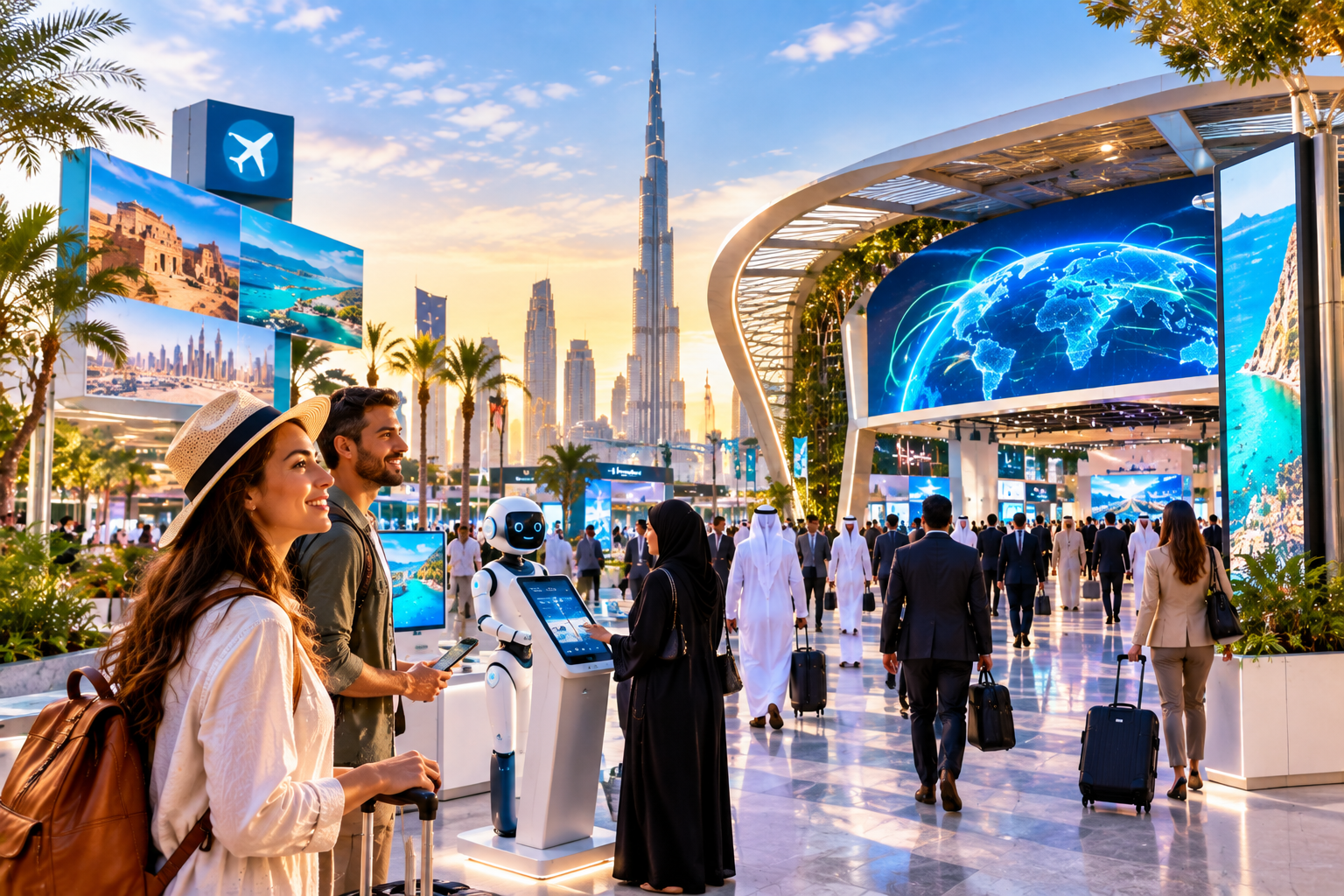

The global travel landscape is crossing into an unprecedented era of expansion and transformation. According to groundbreaking data released by the Arabian Travel Market (ATM), alongside its official research partners STR and Euromonitor International, the Middle East is rapidly cementing its status as the world’s most dynamic travel and tourism powerhouse.
Driven by massive capital investments, revolutionary technology, and structural changes in traveler habits, tourism spending in the Middle East and Africa is forecast to surge by 47.7% by 2030, adding more than $50 billion in direct economic value to the regional tourism market. When evaluating total projected tourism expenditure, the Middle East is on track to hit an astonishing $350 billion annually by 2030.
This is not just a story of recovery; it is the dawn of global travel’s next growth era. Let’s explore how the Middle East is redefining luxury, connectivity, and digital experiences, shaping how the world moves, connects, and explores.
1. The Anatomy of a Tourism Super-Cycle
The global economy has faced what experts call a “poly-crisis”—a period of overlapping geopolitical challenges, inflationary pressures, and shifting market dynamics. Yet, travel has transitioned from a discretionary leisure activity to an essential lifestyle priority.
Instead of cancelling trips due to rising costs, global consumers are adapting. They are prioritizing experience over physical goods, seeking greater booking flexibility, and moving toward regional travel ecosystems that offer rich, deeply personalized encounters.
Nowhere is this resilience more visible than in the Middle East. Backed by clear, long-term state visions—such as Saudi Arabia’s Vision 2030 and the UAE’s long-term tourism initiatives—countries across the region have aggressively built up world-class airports, launched high-capacity regional airlines, and created hyper-luxury cultural and entertainment landmarks.
2. Key Pillars Driving the Middle East’s $350 Billion Tourism Boom
The massive growth expected over the next decade is supported by five pillars:
I. Aviation Re-Engineered
To move hundreds of millions of travelers, you need unparalleled aerial capacity. The region’s four largest carriers—Emirates, Etihad Airways, Qatar Airways, and Saudia—have placed massive orders for nearly 780 aircraft with Boeing and Airbus. This represents a monumental expansion, designed to leverage the Middle East’s geographic location as a hub connecting Europe, Asia, and Africa.
II. The Rise of “Bleisure” and Corporate Giants
Business travel in the Middle East is projected to grow 1.5 times faster than the global average through 2030. The region has transformed into an international headquarters for corporate summits, tech expos, and global trade fairs. As a result, the “bleisure” trend—where business travelers extend their stay for personal holidays—is booming, creating dual-purpose demand for hotels and local tour operators.
III. High-Octane Sports and Entertainment Tourism
Following the operational success of major global events like the FIFA World Cup Qatar 2022 and Expo 2020 Dubai, the region is doubling down on sports and entertainment. Driven by investments in motorsports, golf, soccer, cycling, and esports, sports tourism in the region is projected to experience a 63% growth rate. The upcoming 2034 FIFA World Cup in Saudi Arabia is poised to act as a major catalyst for this segment.
IV. The Global Epicenter of Ultra-Luxury
Luxury in the Middle East is being reimagined. While global luxury travelers typically represent a niche demographic, nearly 60% of travelers drawn to the Middle East habitually spend on premium or ultra-luxury experiences, compared to under 40% globally. This demand is fueling an extraordinary pipeline of ultra-luxury resorts, particularly along the Red Sea and within Saudi Arabia’s giga-projects.
V. Shifts in Source Markets
While Europe remains a massive feeder market, the Middle East is seeing strong growth in travelers from the Asia-Pacific region and Africa. Driven by expanded flight networks and relaxed visa-free arrangements, outbound leisure spending from China to Middle East destinations is expected to surge by 130% by 2030.
3. Country Spotlights: Vision Meets Execution
Several nations are leading this regional transformation with distinct strategic priorities:
4. Innovation and Tech: The Digital Spine of “Travel 2040”
As part of the ATM’s core focus, Travel 2040: Driving New Frontiers Through Innovation and Technology, the industry is seeing physical and digital experiences merge. Innovation is no longer just about back-end efficiencies—it is directly improving the traveler’s journey.
- Zero-Friction Transit: Integrating advanced biometrics, unified digital identities, and single-token passenger travel to reduce airport wait times.
- AI-Enabled Smart Disruption Management: Sophisticated algorithms that predict flight delays, automatically rebook connecting travel, adjust hotel bookings, and coordinate luggage transfers instantly when plans change.
- Hyper-Personalized Booking Engines: Replacing generic search filters with AI assistants that understand natural language, tailoring travel packages around individual interests, diets, and pace.
5. E-E-A-T Analysis: Why the Middle East is the Future of Global Tourism
Under Google’s E-E-A-T guidelines (Experience, Expertise, Authoritativeness, and Trustworthiness), analyzing the travel market requires relying on credible data.
Experience
The Middle East has built a reputation for delivering high-quality hospitality. Over 170 luxury properties are already operating, with dozens more in active development across the GCC. Travel brands in the region are consistently recognized for their high standards of service and customer care.
Expertise
The strategic growth plans of Middle Eastern tourism authorities are guided by world-class urban planners, hospitality experts, and economists. Initiatives like Saudi Arabia’s Vision 2030 are backed by significant financial commitments, ensuring that ambitious plans are supported by solid execution.
Authoritativeness
Collaborative reports from global organizations like the World Travel & Tourism Council (WTTC), Euromonitor International, and STR provide clear, data-driven validation of the region’s trajectory. The Middle East is currently growing at nearly twice the global travel sector rate.
Trustworthiness
The massive commitments from international hotel chains, global airlines, and foreign investors show strong confidence in the region’s long-term tourism infrastructure. These investments highlight the region’s resilience and its growing role in the global travel economy.
6. Embracing the Future of Travel
The findings from the Arabian Travel Market point to a clear conclusion: the global traveler is highly resilient, and the future of travel is experience-driven, digitally integrated, and centered in the Middle East.
As the industry prepares for the next decade of growth, destinations that invest in modern infrastructure, prioritize unique and authentic experiences, and adopt smart technology will lead this exciting new era of global travel.
“When I first read about this update, it instantly reminded me of the absolute headache of wrestling with foreign transport apps on past trips—and honestly, this feature is a total game-changer.”
Have you ever pushed through travel anxieties or flight disruptions just to take a dream trip? Drop a comment and tell me about your most unforgettable travel adventure!
About the Author: Zoey
Zoey is a passionate travel writer and researcher at VentureWibe, dedicated to bringing readers the latest global travel news, inspiring destination guides, and tourism trends from around the world. With a keen eye for uncovering unique travel stories, Zoey helps explorers stay informed and prepared for their next adventures.
- Expertise: Global Tourism, Destination Research, and Travel Insights

Discover more from venture
Subscribe to get the latest posts sent to your email.


**An exciting glimpse into the future of travel. The industry’s growth reflects how exploration, innovation, and global connectivity continue to reshape the way we experience the world. 🌍✈️**