
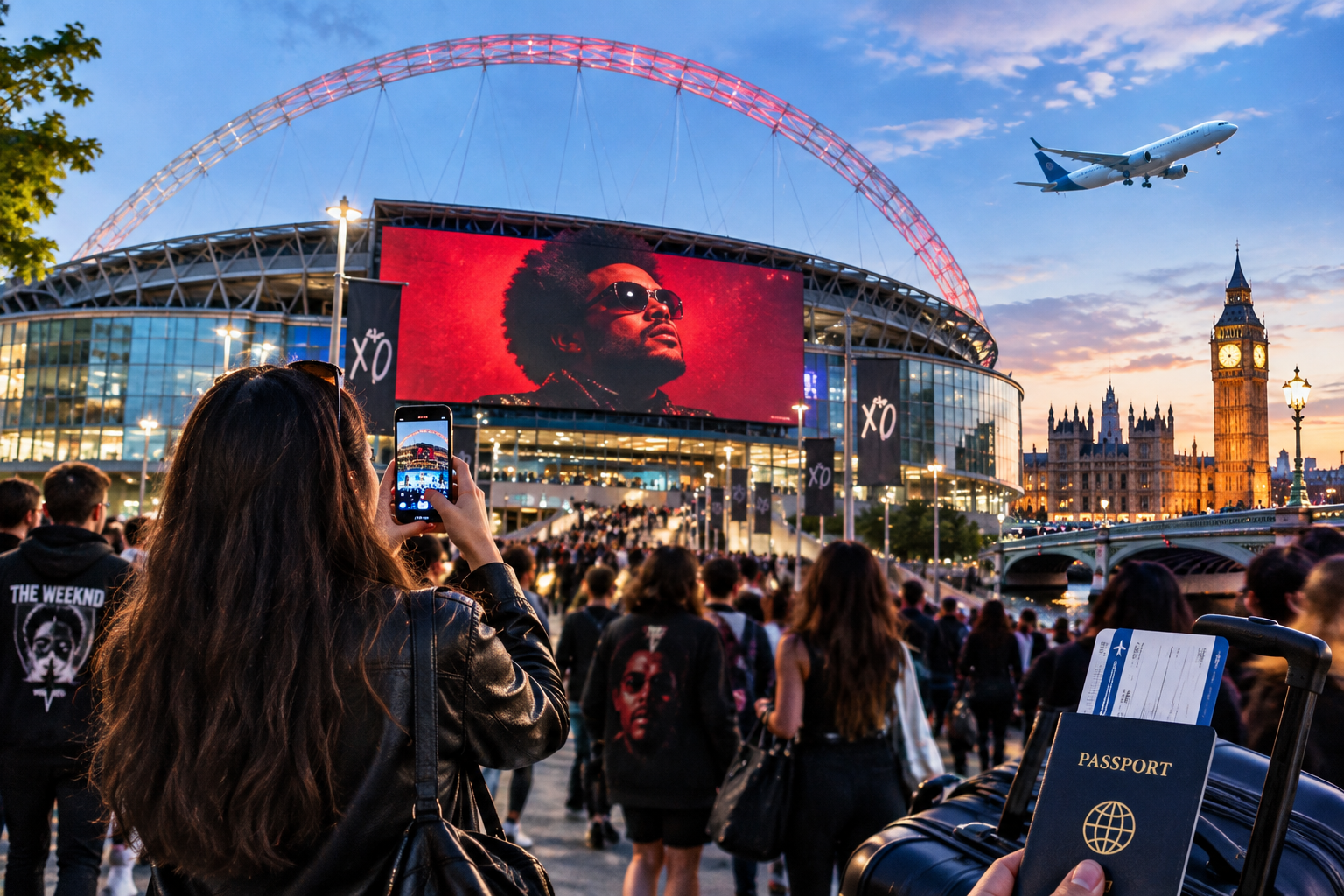
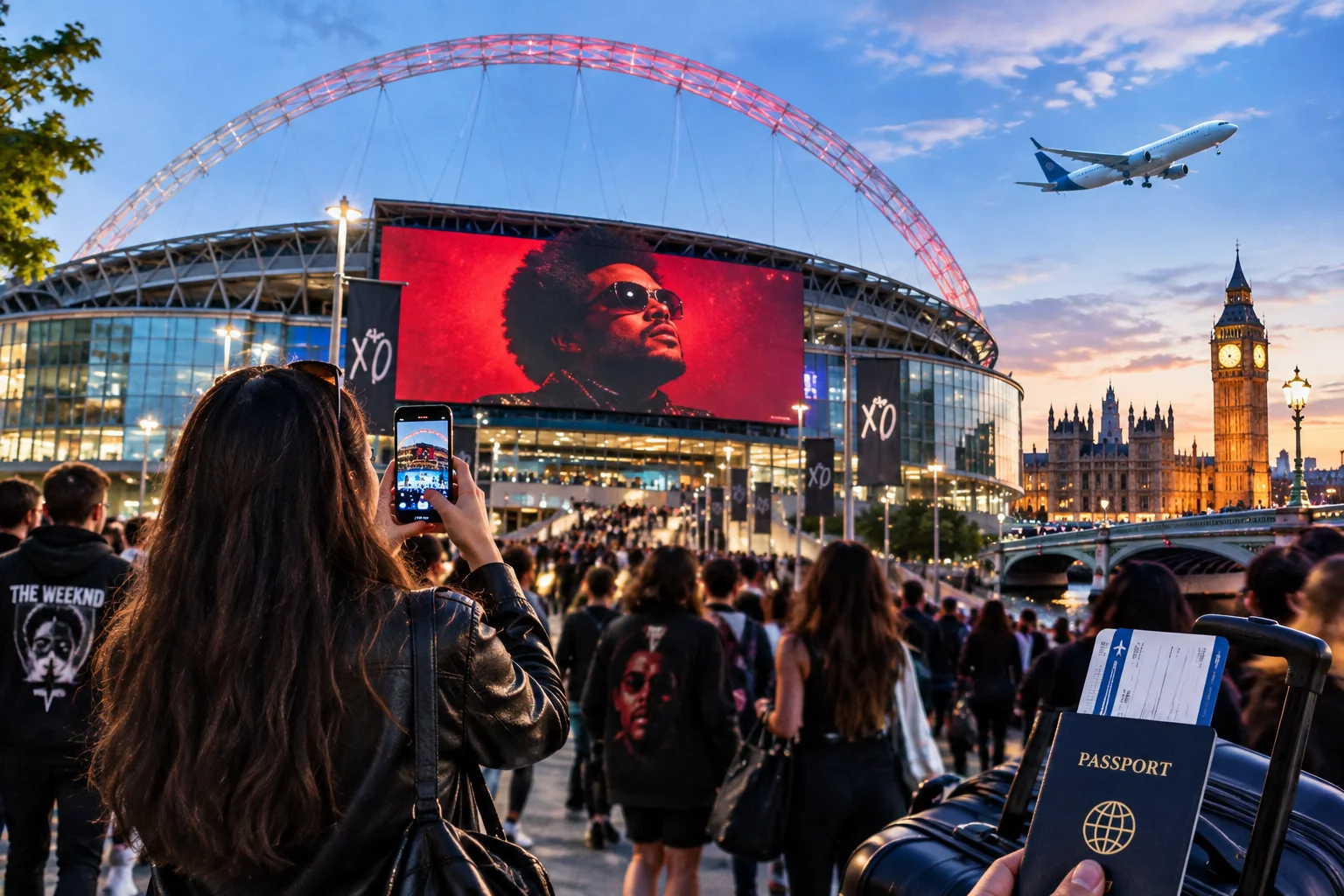
The Weeknd’s Wembley Run Drives Streaming, Tourism and Global Fan Travel
By Achi Benetti | Fame Magazine Pro Feature
August 21, 2026
There is a distinct, electric atmosphere that settles over London when a true global icon takes over the city. Over the past week, that current has hummed louder than usual. Abel Tesfaye—known to billions across the globe as The Weeknd—officially brought the curtain down on his historic, breathtaking five-night residency at the legendary Wembley Stadium.
Combined with an explosive opening double-header at Manchester’s Etihad Stadium, his seven-date United Kingdom summer sweep pulled in an astonishing 450,000-plus fans. But to look at these numbers simply as ticket sales is to miss the forest for the trees. What we witnessed in London and Manchester wasn’t merely a sequence of concerts; it was a masterclass in modern music economics.
The After Hours Til Dawn Stadium Tour has officially redefined how a major musical enterprise functions, creating a massive economic ripple effect that spans international tourism, hospitality, digital streaming surges, and vital global philanthropy.
1. Beyond the Turnstiles: The Monumental Scale of Wembley
When an artist books a five-night stand at a venue as hallowed as Wembley Stadium, stakes are high. For context, very few artists in contemporary music history command that kind of sustained, multi-night demand. Yet, night after night, the stadium—capable of holding over 90,000 ecstatic souls—transformed into a sprawling, dystopian-yet-euphoric cathedral of sound and light.
What makes Tesfaye’s UK footprint unique this time around isn’t just the sheer volume of attendees, but who those attendees were. Live Nation metrics reveal that ticket buyers flew in from nearly 150 different countries.
This is the pinnacle of modern concert tourism. Fans no longer just wait for an artist to visit their local arena; they curate their entire vacations around global tour routes. Die-hard devotees from Tokyo, Toronto, Sydney, and São Paulo packed their bags, booked London hotels, ate at local West End restaurants, and utilized public transit, turning a summer concert run into a multi-million-pound injection into the UK’s tourism and hospitality sectors.
London Mayor Sadiq Khan didn’t mince words when addressing the massive cultural and financial footprint left by the Canadian superstar.
“London has been hugely proud to welcome The Weeknd for more shows than any other city in the world this year,” Khan noted in an official statement.“His five performances have brought hundreds of thousands of fans to Wembley Stadium, providing a huge boost to our tourism and hospitality industries, and showing why London is the music capital of the world.”
2. A Billion-Dollar Empire: The Anatomy of a Record-Breaking Trek
To understand the magnitude of the Wembley run, one must look at the broader trajectory of the After Hours Til Dawn Stadium Tour. Launched back in 2022 and promoted globally by Live Nation, the tour has officially crossed a monumental threshold: grossing more than $1 billion from over 7.5 million tickets sold across 153 stadium dates.
In doing so, it holds the crown as the highest-grossing tour ever achieved by a male solo artist. Behind every milestone of this scale lies relentless execution. Music industry heavyweights Amir “Cash” Esmailian and Wassim “Sal” Slaiby—recently recognized as 2026 Pollstar Impact 50 honorees—have guided this campaign with surgical precision, turning a conceptual album cycle into a globe-spanning cultural phenomenon.
Furthermore, the tour’s executive team has ensured that commercial triumph walks hand-in-hand with social consciousness. Across the European and UK legs, dedicated charitable components—including specific ticket mechanisms where funds support the United Nations World Food Programme (WFP), the XO Humanitarian Fund, and the FIFA Global Citizen Education Fund—raised over $350,000 during the UK run alone.Through initiatives with Global Citizen, countless fans even earned access by taking active steps toward fighting global poverty. It proves that massive stadium scale can—and should—carry a heavy civic responsibility.
3. The Streaming Aftershock: How Live Shows Re-energize a Catalog
One of the most fascinating phenomena of the streaming era is the cyclical relationship between the live stage and digital consumption. When an artist delivers an immersive, multi-sensory live show like After Hours Til Dawn, fans don’t just go home—they log back on, eager to relive the magic.
The UK streaming data following the Wembley residency tells a staggering story:
- Massive Audio Surge:The Weeknd generated over 11 million UK audio streams over the past week alone, marking a whopping 55% increase compared to his previous four-week average.
- Chart Resurgence: His compilation record The Highlights—a project that has spent an astonishing amount of time embedded in the charts—climbed right back up to No. 8 on the UK Official Albums Chart.
- Album Momentum: Studio material received an immediate second wind. His latest full-length project, Hurry Up Tomorrow, more than doubled its weekly sales figures across the UK.
- Deep Cuts Rediscovered: It wasn’t just the mega-hits like Blinding Lights or Starboy that benefited. Spotify’s UK charts saw deep-cut treasures like House Of Balloons / Glass Table Girls surge onto the list, alongside heavy rotation for tracks like One Of The Girls and The Hills.
This proves a vital truth of the 21st-century music business: Live touring is the greatest marketing engine in existence. A stadium show drives physical presence, which fuels emotional connection, which subsequently sends millions of listeners straight back to DSPs (Digital Service Providers) to stream everything from current singles to 2011 underground mixtapes.
4. The Global Blueprint: What Lies Ahead
With the dust finally settling over the hallowed turf of Wembley, Abel Tesfaye is showing zero signs of slowing down. The global music machine moves fast. Even as the UK bids farewell to its summer resident, the After Hours Til Dawn Tour continues its relentless global conquest.
The immediate horizon takes the production across more of Europe, with high-profile, sold-out multi-night stops waiting at Croke Park in Dublin, the Riyadh Air Metropolitano in Madrid, Estadi Olímpic Lluís Companys in Barcelona, and Estadio do Restelo in Lisbon.
Following Europe, the production pivots eastward for an expansive autumn leg across Asia.Originally slated as an 11-date run, overwhelming global demand forced promoters to expand the itinerary to a massive 17-date stadium sweep.Cities like Tokyo (Belluna Dome), Jakarta (Jakarta International Stadium), Singapore (National Stadium), Seoul (Goyang Stadium), Bangkok (Rajamangala Stadium), Hong Kong (Kai Tak Stadium), and Kuala Lumpur are preparing for the exact same wave of economic electricity, tourism influx, and streaming spikes that London just experienced.
Final Thoughts: The Complete Ecosystem
The Weeknd’s five-night Wembley residency serves as a case study for the modern entertainment landscape. We are past the era where an album release and a tour lived in separate silos. Today’s music industry ecosystem relies on a delicate, powerful alchemy: live performance revenue, international tourism pipelines, cross-border fan travel, and immediate digital streaming feedback loops.
As fans pack their bags for Dublin, Madrid, or Tokyo, one thing is abundantly clear. Abel Tesfaye isn’t just filling stadiums—he is rewriting the rulebook on how global superstardom is sustained in real time. The lights at Wembley may have gone down, but the shockwaves of his historic UK run will echo across the global music landscape for months to come.
“When I first read about this update, it instantly reminded me of the absolute headache of wrestling with foreign transport apps on past trips—and honestly, this feature is a total game-changer.”
Have you ever pushed through travel anxieties or flight disruptions just to take a dream trip? Drop a comment and tell me about your most unforgettable travel adventure!
About the Author: Zoey
Zoey is a passionate travel writer and researcher at VentureWibe, dedicated to bringing readers the latest global travel news, inspiring destination guides, and tourism trends from around the world. With a keen eye for uncovering unique travel stories, Zoey helps explorers stay informed and prepared for their next adventures.
- Expertise: Global Tourism, Destination Research, and Travel Insights

Discover more from venture
Subscribe to get the latest posts sent to your email.

