
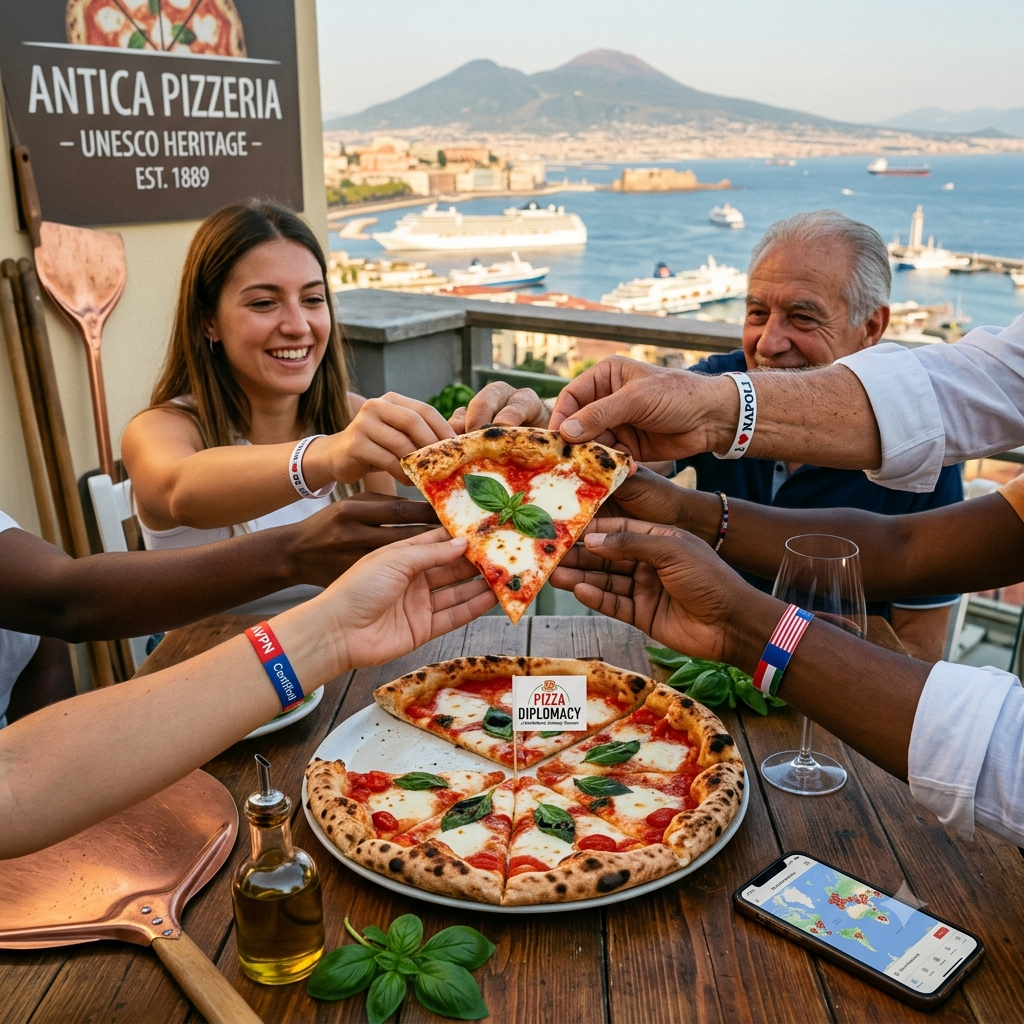
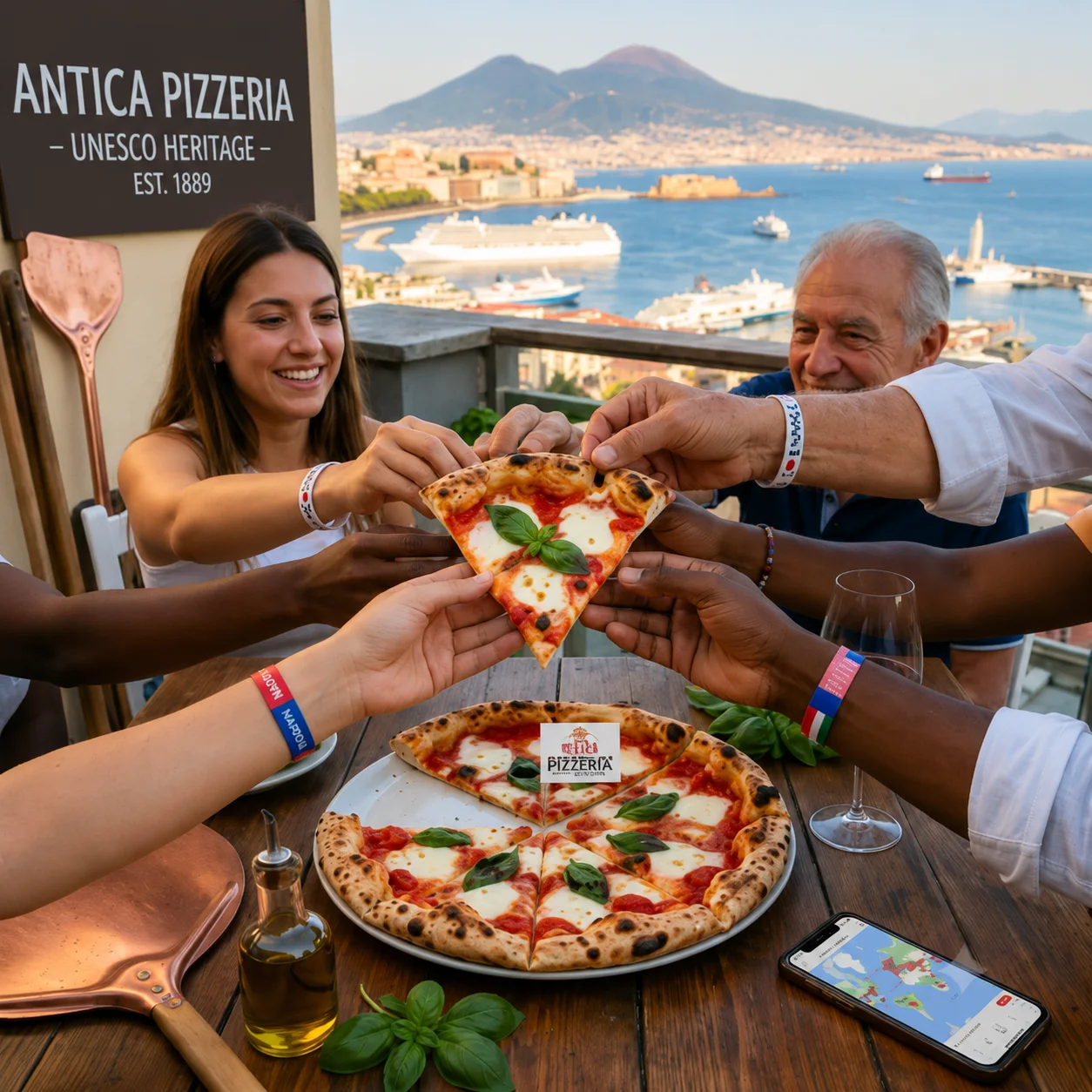
Pizza Diplomacy: How One Slice Connects the World Through Tourism
By eTurboNews Travel & Gastronomy Desk
“Politics divides us. Religion separates us. Sports create lifelong rivalries. But hand almost anyone a warm, golden slice of pizza, and chances are they will smile before asking only one crucial question: ‘What’s on it?'”
The Universal Language of the Oven
There is a distinct, hypnotic sound that echoes inside a 900-degree wood-fired oven: the crackle of oak logs, the soft sizzle of olive oil meeting blistered dough, and the gentle scraping of a long-handled copper peel against volcanic stone. In Naples, Italy, this sound is the heartbeat of the historic city center. In Brooklyn, Tokyo, São Paulo, and Buenos Aires, it is the universal call to dinner.
Food has long served as humanity’s most potent soft power asset. While ambassadors exchange formal treaties in climate-controlled conference rooms, true cross-cultural understanding happens across wooden tables dusted with flour and smeared with San Marzano tomatoes.
Welcome to the era of Pizza Diplomacy—the global phenomenon where a humble flatbread, once dismissed as peasant street fare in 18th-century Southern Italy, has evolved into the world’s most effective passport for tourism, economic development, and cultural exchange.
Across the globe, culinary tourism now accounts for a massive segment of the international travel industry. According to global tourism data, over 90% of leisure travelers list food experiences as a primary driver when choosing their destination. Among all dishes on Earth, pizza reigns supreme as the most recognizable, accessible, and endlessly customizable culinary creation.
From Neapolitan Alleys to Royal Palaces: The Birth of a Legend
To understand how pizza became the connective tissue of modern tourism, one must trace its journey from the cramped, poverty-stricken quarters of Naples to the royal courts of Europe and the bustling streets of Manhattan.
The Street Food of the Lazzaroni
In the late 18th century, Naples was one of Europe’s most densely populated cities. Thousands of working-class poor—known as the lazzaroni—lived in tiny, windowless single-room dwellings without cooking facilities. They required food that was cheap, quick to consume on the go, and packed with energy.
Local bakers met this demand by topping simple flatbreads with lard, garlic, salt, coarse cheese, and—eventually—the newly arrived New World import: the tomato.
For decades, aristocratic visitors on the European “Grand Tour” looked upon Neapolitan pizza with disdain. Writing in 1835, French author Alexandre Dumas noted that pizza was the primary nourishment of the Neapolitan poor, observing that it reflected the economic tide of the city. It was viewed not as fine dining, but as an emblem of poverty.
The turning point arrived in June 1889. King Umberto I and Queen Margherita of Savoy visited Naples. Tired of the formal French cuisine served to royalty, the Queen summoned Raffaele Esposito, the premier pizzaiuolo (pizza maker) of Pizzeria Brandi. Esposito prepared three varieties, including one decorated in the colors of the newly unified Italian flag: green basil, white mozzarella, and red tomato.
Queen Margherita was enthralled. Esposito named the pie “Pizza Margherita” in her honor, bestowing royal legitimacy upon a dish that had once been spurned by polite society.
The Anthropological Marvel: The “Pizza Effect” in Tourism
In 1970, Syracuse University anthropologist Agehananda Bharati coined a socio-cultural term that remains essential to understanding modern travel: The Pizza Effect.
The Pizza Effect: The cultural phenomenon wherein a local, often underappreciated practice or dish is exported to another region, transformed and elevated through international enthusiasm, and subsequently re-imported back to its homeland with elevated status and newfound domestic pride.
When southern Italian immigrants moved to North and South America at the turn of the 20th century, they brought their dough recipes with them. In cities like New York, Chicago, and Buenos Aires, pizza expanded in scale, richness, and variety. Following World War II, returning American soldiers who had developed a taste for pizza overseas demanded it at home, igniting an explosive commercial expansion.
As international tourism to Italy surged during the postwar economic boom, foreign tourists arrived in Rome, Florence, and Venice asking for “authentic Italian pizza”. At the time, regional Italian cooking was fiercely localized; Northern Italians rarely ate pizza. However, to satisfy high-spending international visitors, restaurateurs across the entire Italian peninsula began building pizza ovens.
International tourism took a regional Neapolitan specialty and transformed it into Italy’s national brand identity.
UNESCO and the Intangible Heritage of the Pizzaiuolo
In December 2017, the United Nations Educational, Scientific and Cultural Organization (UNESCO) officially inscribed the “Art of the Neapolitan ‘Pizzaiuolo'” onto its Representative List of the Intangible Cultural Heritage of Humanity.
This recognition was a historic milestone for gastrodiplomacy. UNESCO did not merely safeguard the physical ingredients—flour, water, yeast, salt, tomato, mozzarella—but rather the cultural ritual, ritualized body movements, and intergenerational knowledge passed down through generations.
Today, the Associazione Verace Pizza Napoletana (AVPN) acts as a global diplomatic corps, sending master pizzaioli to certify restaurants across more than 80 nations. A certified pizzeria in Kyoto, Frankfurt, or São Paulo operates as a micro-embassy of Neapolitan culture, maintaining strict standards that mandate San Marzano tomatoes grown in the volcanic soil of Mount Vesuvius and Mozzarella di Bufala Campana DOP.
A World of Styles: Regional Pizzerias as Cultural Ambassadors
While Naples remains the spiritual capital, pizza’s global journey has fostered remarkable local expressions. Each destination infuses its regional identity, agricultural landscape, and cultural heritage into the dough.
1. Tokyo: The Japanese Masterclass in Precision
In the backstreets of Tokyo’s Meguro and Roppongi districts, Japanese pizza masters such as Susumu Kakinuma (Pizzeria Seirinkan) and Tsubasa Tamaki (Pizzeria PST) have taken Neapolitan craft to extraordinary levels of refining. By meticulously adjusting dough hydration based on daily humidity and utilizing local Japanese hardwoods, Tokyo pizzerias regularly claim top honors in international global rankings, drawing thousands of food-focused travelers to Japan every year.
2. São Paulo: The Pizza Capital of South America
With over 6,000 pizzerias producing more than one million pies daily, São Paulo boasts one of the world’s most vibrant pizza cultures outside Italy. Influenced by massive Italian migration in the late 19th and early 20th centuries, Brazilian pizza emphasizes rich, communal dining experiences. Toppings like creamy catupiry cheese, shredded chicken, and hearts of palm celebrate local agricultural bounty alongside European tradition.
3. The American Spectrum: From NY Slices to Detroit Steel
In the United States, pizza transformed into a tapestry of regional pride:
- New York City: Built on coal-fired and gas deck ovens, yielding wide, thin-crust slices engineered to be folded in half while walking.
- Chicago: Deep-dish creations baked in high-walled pans, featuring thick layerings of mozzarella beneath savory, crushed tomato sauce.
- Detroit: Square-cut pies baked in industrial blue-steel automotive utility trays, characterized by a crispy, caramelized cheese edge (frico).
Gastrodiplomacy: How Food Builds Bridges
Gastrodiplomacy—the deliberate use of culinary heritage to enhance a nation’s global reputation, drive tourism, and foster cross-cultural friendship—has embraced pizza as its ultimate vehicle.
Food is an effective soft power tool because it bypasses linguistic barriers and ideological differences. As noted by food culture analysts, sharing a meal lowers defensive barriers and creates shared human connection.
The Great Pineapple Debate: Culinary Friction as Cultural Dialogue
Few culinary debates evoke as much passion across borders as Hawaiian pizza—top-heavy with ham and pineapple. Invented in Canada in 1962 by Greek immigrant Sam Panopoulos, the pineapple topping sparked international dialogue.
When the President of Iceland jokingly remarked in 2017 that he would ban pineapple on pizza if he had the power, it triggered a worldwide internet event. Diplomats, chefs, and everyday tourists weighed in, sparking conversations about regional culinary authenticity, migration, and innovation.
As highlighted in first-person travel accounts, ordering a pineapple and jalapeño pie in Germany led not to culinary exclusion, but to a lively discussion with the local chef about Hawaiian culture, tropical ingredients, and personal food histories. In this light, even culinary controversies serve as entry points for cultural exchange and international understanding.
The Economic Impact of Pizza Tourism
Culinary tourism centered on pizza generates billions of dollars in revenue for airlines, hospitality groups, local farms, and artisanal producers worldwide.
The Naples “Pizza Village” Model
Every summer, the Lungomare waterfront in Naples transforms into the world’s largest open-air pizzeria for Pizza Village. Spanning over a kilometer, the festival features dozens of wood-fired ovens operated by renowned master pizzaioli. Attracting over 1 million visitors annually from more than 50 nations, the event drives hotel occupancies, boosts local transportation networks, and highlights Campania’s agricultural supply chains.
Hands-On Masterclasses: The Rise of Experiential Travel
Modern tourists increasingly prioritize immersive experiences over passive sightseeing. Cooking schools from Amalfi to Brooklyn offer hands-on pizza workshops:
- Travelers learn dough hydration science, fermentation mechanics, and fire management.
- Visitors return home as certified brand ambassadors for authentic ingredients and culinary traditions.
- Agritourism farms offer field-to-table tours showcasing wheat harvesting, cheese production, and olive pressing.
The Recipe for Connection: How Pizza Unites Us
At its core, pizza’s global triumph lies in its fundamental simplicity and adaptability. It is a blank canvas that invites collaboration rather than isolation.
Whether you are sharing a classic Margherita under the Mediterranean sun, enjoying a folded fold-over slice on a street corner in Manhattan, or sampling a truffle-infused pie in a high-rise dining room in Tokyo, you are taking part in a global tradition that spans centuries.
Pizza reminds us that despite our political boundaries, cultural differences, and geographical distances, we all share a seat at the same global table.
“When I first read about this update, it instantly reminded me of the absolute headache of wrestling with foreign transport apps on past trips—and honestly, this feature is a total game-changer.”
Have you ever pushed through travel anxieties or flight disruptions just to take a dream trip? Drop a comment and tell me about your most unforgettable travel adventure!
About the Author: Zoey
Zoey is a passionate travel writer and researcher at VentureWibe, dedicated to bringing readers the latest global travel news, inspiring destination guides, and tourism trends from around the world. With a keen eye for uncovering unique travel stories, Zoey helps explorers stay informed and prepared for their next adventures.
- Expertise: Global Tourism, Destination Research, and Travel Insights

Discover more from venture
Subscribe to get the latest posts sent to your email.


That pizza looks yummy! Breaking bread together is always a wonderfully, delightful way to connect!