
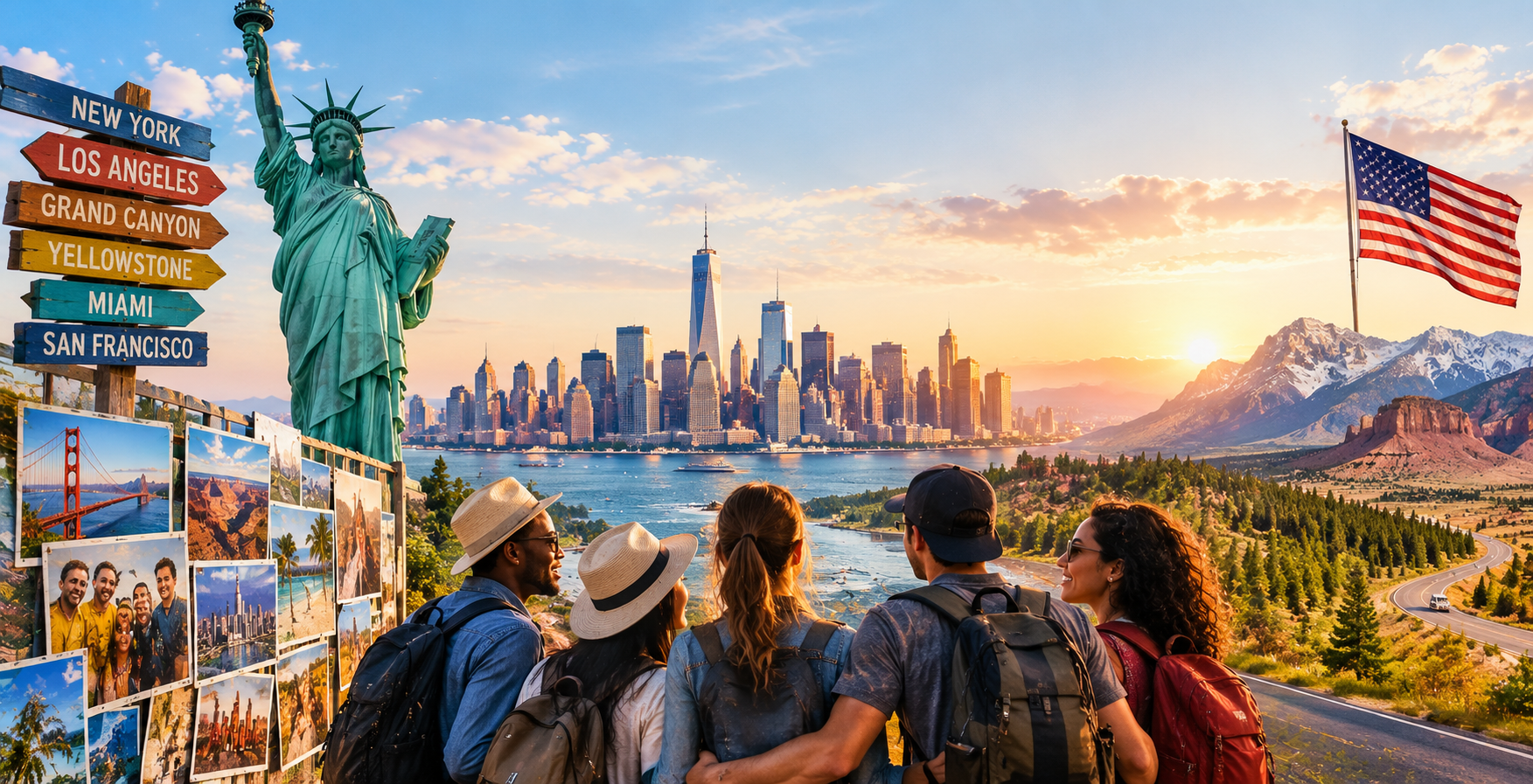

Beyond the Border Wall of Perceptions: How Tourism Can Rebuild America’s Global Image
Introduction: The Soft Power Deficit and the Horizon of Renewal
For decades, the global imagination was captured by an idealized narrative of the United States. It was painted in the broad, cinematic strokes of neon-lit Broadway avenues, the sun-drenched expanse of Pacific Coast Highways, the misty majesty of the Great Smoky Mountains, and the pulsing, creative chaos of cities like Chicago, New Orleans, and New York. America’s greatest export was never merely its manufactured goods, its software, or its financial instruments; it was its soft power—the magnetic pull of its cultural inclusivity, its dynamic diversity, and the promise of the American Dream.
However, soft power is not a permanent endowment. It is a living, breathing ecosystem built on human encounters, mutual trust, and the perception of safety and hospitality. In recent years, that ecosystem has faced unprecedented stress. Political shifts, sharp rhetoric, tightening border controls, and polarizing administrative policies—frequently tracked by global analysts and industry insiders as the core drivers behind consecutive waves of international travel slumps or the so-called “Trump Slump”—have left deep scars on how the world views the United States. International arrivals have lagged behind global post-pandemic recovery booms, long-standing allies like Canada have recorded historic double-digit drops in cross-border travel, and a pervasive “sentiment drag” has caused prospective travelers across Europe, Asia, and Latin America to direct their passports and spending power toward competing destinations in Europe and Asia.
As the nation looks toward a post-Trump future—an era defined by the inevitable need for national introspection and international re-engagement—rebuilding America’s global image cannot be achieved through traditional diplomacy alone. State department cables, diplomatic summits, and geopolitical treaties are vital, but they remain abstract to the average global citizen.
The most potent, visceral, and effective tool for repairing the fractured tapestry of America’s international reputation is tourism.
This comprehensive exploration examines how the travel and hospitality sector can spearhead a national renaissance, transforming millions of international visitors from hesitant onlookers back into passionate ambassadors for the United States.
Part I: The Anatomy of the Decline – Understanding the “Sentiment Drag”
To chart a course toward recovery, we must first diagnose the malady. The contraction of international tourism to the United States is not merely a byproduct of economic headwinds, foreign exchange fluctuations, or post-pandemic consumer shifts; it is fundamentally a crisis of perception and policy.
1. The Chilling Effect of Exclusionary Rhetoric
When political discourse frames visitors and immigrants through a lens of suspicion, the ripples are felt immediately at international booking desks. Policies characterized by aggressive border crackdowns, visa freezes, enhanced social media vetting, and high-profile legal hurdles create an underlying anxiety.
For a potential tourist sitting in Toronto, London, Tokyo, or Berlin, choosing a holiday destination involves an emotional calculation. If the prevailing message from a country’s leadership is that foreigners are unwelcome, intrusive, or subject to arbitrary administrative friction, travelers vote with their feet. Data from organizations like the World Travel & Tourism Council (WTTC) and regional studies illustrate this stark reality: while global travel hit record-breaking highs following the reopening of international borders, the United States saw significant contractions in inbound traffic, proving that travelers actively bypassed American ports of entry in favor of more welcoming jurisdictions.
2. The Economic Fallout of Isolationism
The drop in foreign visitation is often minimized by political hardliners who underestimate its economic footprint. Yet, international tourism is an export-driven economic powerhouse. Foreign visitors do not merely sightsee; they inject trillions of dollars into local economies, supporting millions of American jobs in hotels, restaurants, airlines, museums, tour companies, and retail storefronts.
When international travelers stay away, the pain is felt acutely on Main Street. Small businesses in iconic gateway cities—New York, Los Angeles, San Francisco, Miami, Orlando, and Honolulu—experience compressed margins. Bartenders, concierges, small boutique owners, and hospitality workers bear the brunt of reduced tips and hours. Consequently, restoring America’s global image via tourism is not just an exercise in public relations or national vanity; it is an urgent economic imperative essential for domestic prosperity.
Part II: The Blueprint for Rehabilitation – Policy, Perception, and People
Rebuilding the U.S. brand in a post-Trump landscape requires a multi-pronged, bipartisan strategy that marries structural policy reform with grassroots hospitality. We cannot simply market our national parks and museums while maintaining an unwelcoming administrative perimeter.
1. Overhauling Visa Systems and Entry Protocols
The friction of entering the United States is legendary among international travelers. Protracted consular interview wait times, cumbersome documentation requirements, and unpredictable secondary screening procedures at airports frequently brand America as difficult and adversarial.
A post-Trump tourism recovery strategy must modernize and humanize entry processes:
- Streamlined Visa Processing: Investing heavily in consular staffing abroad to slash interview backlogs.
- Smart Expansion of Visa-Waiver Programs: Re-evaluating and expanding partnerships with emerging middle-class markets whose citizens represent high-value, low-risk tourist demographics.
- Human-Centric Customs Experiences: Transforming ports of entry from intimidating checkpoints into welcoming gateways, ensuring that border personnel are trained in modern customer service and cultural sensitivity without compromising national security.
2. Countering the Narrative: From “America First” to “America Open and Connected”
Initiatives like Brand USA’s “America the Beautiful” and “American Originals” campaigns, alongside fact-checking and reassurance platforms, represent early attempts by the travel industry to stem the tide. However, marketing slogans ring hollow if they are contradicted by daily headlines.
To truly shift global sentiment, American leadership must articulate a clear vision that re-establishes the nation as a collaborative global citizen. Tourism boards, cultural institutions, and municipal leaders must work in tandem to amplify stories of regional warmth, diversity, and cultural exchange. When international travelers see that American communities cherish multiculturalism and local hospitality, the dissonance between government rhetoric and everyday American life begins to dissolve.
Part III: The Grassroots Power of Hospitality – How Tourism Heals Divides
National reputation is ultimately decentralized. It is shaped less by what a president says in a televised speech and more by how an individual traveler is treated by a desk clerk in Chicago, a park ranger in Utah, or a waiter in New Orleans.
1. Human-to-Human Diplomacy
Tourism is the ultimate form of peer-to-peer diplomacy. When a family from Germany, a student group from South Korea, or a couple from Brazil vacations in the United States, they experience the granular reality of American society. They interact with neighbors, share meals in local diners, and participate in community spaces.
These personal touchpoints dismantle stereotypes. They remind the world that political administrations are temporary, but the American spirit—characterized by generosity, innovation, and warm curiosity—remains constant. Every successful vacation experience turns a foreign visitor into an organic advocate, countering hostile narratives back home with authentic stories of kindness and wonder.
2. Leveraging Mega-Events as Catalysts for Change
The timing of global mega-events provides a unique springboard for this rehabilitation. With high-profile international sporting events—most notably the FIFA Men’s World Cup and subsequent global gatherings—stepping onto American soil, the nation has a captive audience of billions.
To maximize these opportunities, administrative policies must bend toward hospitality. For instance, the strategic waiver of restrictive bond requirements for tournament ticket holders demonstrated that when forced to choose between rigid bureaucratic hurdles and global celebration, pragmatism can prevail. Maintaining and expanding this pragmatic, welcoming posture long after the final whistle blows is essential for sustained tourism revival.
Part IV: Strategic Pillars for a Post-Trump Tourism Renaissance
To achieve a lasting transformation in America’s global standing through travel, industry leaders, policymakers, and destination marketing organizations must execute a rigorous, long-term action plan divided into four core pillars.
Pillar 1: Bipartisan Consensus on Soft Power
Tourism cannot be treated as a partisan political football. If tourism policies swing violently with every change in the White House, international tour operators, airlines, and travelers will permanently allocate their capital and itineraries elsewhere. A stable, bipartisan framework recognizing tourism as a vital component of national security and economic health must be forged. Lawmakers from both sides of the aisle must champion policies that encourage international mobility, educational exchanges, and cultural tourism.
Pillar 2: Sustainable and Inclusive Regional Promotion
The traditional tourist trail—focused strictly on a few hyper-expensive gateway metropolises—must expand. High costs in cities like New York and San Francisco often price out middle-class international travelers.
Encouraging travel to America’s heartland, secondary cities, indigenous communities, and lesser-known national parks distributes economic benefits more equitably while showcasing the multifaceted depth of American culture. Regional destination marketing organizations must target emerging international markets with tailored, culturally resonant campaigns that highlight local culinary scenes, outdoor adventure, and historical heritage.
Pillar 3: Leveraging Digital Innovation and AI in Travel Safety
Modern travelers value frictionless, transparent journeys. Utilizing artificial intelligence and advanced digital infrastructure can dramatically improve the visitor experience. From seamless biometric boarding and instant digital visa renewals to AI-powered multilingual concierge services in national parks and transit hubs, technology can eliminate the administrative anxiety that deters prospective visitors. Furthermore, transparent communication regarding safety, travel advisories, and local customs builds deep trust before a traveler even boards a flight.
Pillar 4: Fostering Academic and Cultural Exchanges
Tourism is inextricably linked to educational travel. Restrictions on international students and academic researchers under hardline administrations have severely damaged America’s standing as the global epicenter of intellectual innovation.
A post-Trump resurgence must actively roll out the red carpet for international students and scholars. Academic institutions are incubators for future global leaders; when international students feel welcomed, respected, and protected in American university towns, they build lifelong emotional ties to the United States that endure for generations.
Part V: The Global Economic Imperative – Competing in a Reshaped World
As global tourism accelerates past post-pandemic milestones, the international marketplace is more competitive than ever. Nations across Europe, the Middle East, and Asia are investing billions in state-of-the-art airport infrastructure, simplified e-visa systems, and aggressive global marketing campaigns.
The United States can no longer rely on its historical reputation as an automatic bucket-list destination. Inertia is no longer an option. If America fails to actively repair its image and ease entry barriers, it will continue to forfeit market share, losing not just tourist dollars, but its preeminent position in the global imagination.
Rebuilding this image via tourism requires an acknowledgment that openness is a sign of strength, not weakness. A confident nation does not fear temporary visitors; it welcomes them, dazzles them with its natural and cultural wonders, and sends them home as lifelong champions of its values.
Conclusion: Welcoming the World Anew
The arc of history bends toward connection. While political cycles will continue to fluctuate, and the polarization of the Trump era has left deep structural and perceptual challenges, the foundational pillars of American appeal remain profoundly resilient. The vast expanses of the American landscape, the boundless creativity of its diverse people, and the pioneering spirit of its communities still possess an unmatched allure.
Rebuilding America’s global image after the storms of recent political isolationism will not happen overnight. It requires patience, policy reform, financial investment, and, above all, a collective cultural commitment to radical hospitality.
By opening our borders with grace, simplifying our entry systems, celebrating our diverse cultural mosaic, and treating every foreign traveler as an honored guest rather than a suspect, we can do more than just restore profit margins for the hospitality sector. We can heal the fractures in our global relationships, prove that our democracy is self-correcting and welcoming, and reclaim our rightful place as a beacon of light, openness, and inspiration to the world.
When a Government’s Image Is Not Its People’s Identity: A Pledge to the World
This video provides vital context and analysis on how shifting U.S. immigration and visa policies under the Trump administration have impacted international tourism, student migration, and America’s overarching global soft power.
“When I first read about this update, it instantly reminded me of the absolute headache of wrestling with foreign transport apps on past trips—and honestly, this feature is a total game-changer.”
Have you ever pushed through travel anxieties or flight disruptions just to take a dream trip? Drop a comment and tell me about your most unforgettable travel adventure!
About the Author: Zoey
Zoey is a passionate travel writer and researcher at VentureWibe, dedicated to bringing readers the latest global travel news, inspiring destination guides, and tourism trends from around the world. With a keen eye for uncovering unique travel stories, Zoey helps explorers stay informed and prepared for their next adventures.
- Expertise: Global Tourism, Destination Research, and Travel Insights

Discover more from venture
Subscribe to get the latest posts sent to your email.


[…] Beyond the Border Wall: How Tourism Can Rebuild America’s Global Image – venture […]
What a wonderous clearing house of tourism and international travel you have hear, Zoey! Thank you for visiting my blog and like Lewis Carroll’s White Rabbit, leading me here! (From the story, “Alice in Wonderland,” by Lewis Carroll)
–
I wonder…have you any articles on tourist and heritage railways and their associated economic history?