
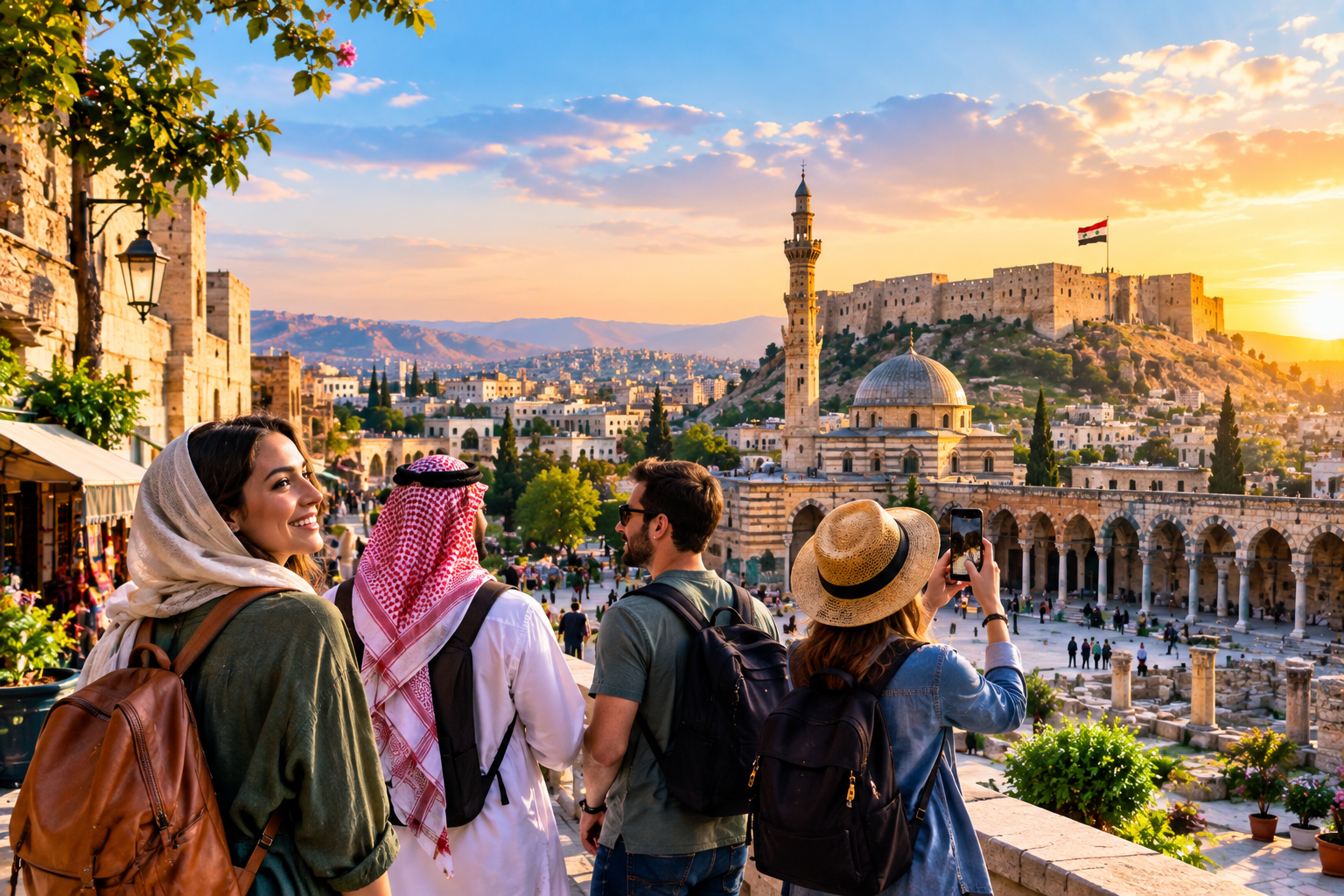

Arab Visitors Double as Syria’s Tourism Draws Global Attention
Executive Summary: Syria’s travel sector has recorded a historic resurgence in the first half of 2026. Driven by a 107% surge in regional Arab visitors and an astounding 448% jump in international tourists, total visitor arrivals reached 3.52 million—more than double the figures from the previous year. Supported by major aviation reconnections, multi-million dollar luxury hospitality developments, and strong diaspora returns, the Levantine nation is executing an ambitious shift from crisis management toward a sustainable, tourism-led economic model.
1. The Great Turnaround: Deconstructing H1 2026 Numbers
The Eastern Mediterranean travel landscape is witnessing a dramatic reallocation of tourist flows. Official data released by the Syrian Ministry of Tourism (MoT) reveals that 3.52 million total visitors crossed Syrian borders between January and June 2026. This represents a 111% year-on-year increase compared to the 1.67 million recorded during the same period in 2025.
To put this acceleration into perspective, Syria welcomed nearly as many total visitors in the first six months of 2026 as it recorded during the first 11 months of 2025 combined.
These metrics confirm that Syria is no longer relying solely on necessity travel or local border trade. Instead, it is emerging as a destination for regional weekenders, heritage enthusiasts, business travelers, and long-haul cultural explorers.
2. Regional Renaissance: Why Arab Visitors are Flocking Back
Arrivals from Arab nations grew by 107% to 664,000 during H1 2026. This resurgence is grounded in a combination of diplomatic normalization, streamlined border crossings, and deep-seated cultural affinity.
The Jordan–Syria Corridor
Jordan holds the largest market share of incoming Arab tourists. Upgrades at the Nassib border crossing, simplified visa protocols, and favorable currency exchange rates have turned Damascus into a prime destination for Jordanian leisure travelers, shoppers, and families.
The Lebanese & Iraqi Channels
Lebanon remains Syria’s second-largest Arab source market, with cross-border transport seeing double-digit expansion. Iraq follows closely, driven by leisure travel, commercial visits, and religious pilgrimage tours.
Gulf Cooperation Council (GCC) Momentum
While overall volumes from Saudi Arabia, the UAE, Kuwait, Qatar, and Bahrain are smaller than land-adjacent neighbors, their economic weight is significant. Gulf travelers represent high-yielding tourist arrivals who spend longer periods in boutique accommodations, dine at luxury establishments, and drive demand for private transport and tailored tour packages.
3. Beyond the Region: The 448% Surge in Global Tourists
The most surprising figure in the Ministry of Tourism’s report is the 448% explosion in foreign, non-Arab arrivals, rising from 131,000 in H1 2025 to 719,000 in H1 2026.
The top non-Arab source market is Türkiye, facilitated by proximity and cross-border commercial links. However, the remaining top spots are dominated by Western nations:
- Germany
- Sweden
- United States
- The Netherlands
- Canada
- United Kingdom
This diversification demonstrates that Syria’s tourism appeal is expanding beyond immediate geographic neighbors into key North American and European traveler bases.
4. Key Pillars Driving the Global Attraction
A. Ancient Heritage & World Heritage Sites
Syria houses six UNESCO World Heritage sites:
- The Ancient City of Damascus: Continuously inhabited for thousands of years, renowned for its Omayyad Mosque, centuries-old souks, and restored courtyard mansions.
- Aleppo’s Citadel & Historic Quarter: Active restoration projects have re-opened core sections of the ancient souks and historic plazas.
- Krak des Chevaliers (Qal’at al-Husn): Widely regarded as one of the best-preserved medieval crusader castles in the world.
- Palmyra, Maaloula, & Bosra: Key historical sites drawing architectural scholars, photographers, and heritage travelers.
B. The Expatriate Engine: 2.13 Million Returnees
Syrian diaspora visits grew 75% to 2.13 million in H1 2026. As Tourism Minister Mazen Al-Salhani noted:
“Syrian expatriates are far more than a visitor segment; they are ambassadors for Syria around the world, sharing the country they experience today with their communities abroad. Every returning Syrian helps restore international confidence and anchor Syria on the global tourism map.”
Returning expatriates stimulate local economies by renting short-term apartments, purchasing real estate, supporting local dining and retail, and organizing group travel for non-Syrian colleagues.
5. Aviation Restorations & Capital Investments
To sustain this surge, the Ministry of Tourism, in coordination with the Ministry of Transport, has prioritized infrastructure recovery and air connectivity.
Key Infrastructure Highlights:
- Aviation Expansion: Carriers like Etihad Airways are reinstating direct routes—such as Abu Dhabi to Damascus—significantly improving regional transit options.
- Khan Suleiman Pasha (Damascus): A landmark 18th-century Ottoman caravanserai converted into a 5-star boutique hotel, blending historic architecture with modern luxury.
- “The Beaumont” Development: A flagship $250 million to $300 million mixed-use development featuring international brand hotel rooms, serviced apartments, and retail spaces.
- Coastal & Eco-Tourism Expansion: Increased capital allocation in Tartus and Latakia to develop coastal resorts, alongside mountain eco-lodges in the Al-Ansarieh range.
6. Challenges and Strategic Horizon
While the 111% growth in arrivals highlights rapid momentum, several key structural hurdles remain:
- Hotel Room Supply Deficit: Peak summer months are testing hotel capacity in Damascus, Aleppo, and coastal regions.
- Power Grid & Infrastructure Needs: Sustained private investment is required for stable energy supply and modern transportation networks.
- Electronic Payments & Visa Processing: Streamlining international card payments and digital e-visa systems will be critical to sustaining double-digit growth.
Looking toward the remainder of 2026, the Ministry of Tourism forecasts a robust third quarter supported by summer festivals, cultural events, and steady regional traffic. By converting short-term visits into sustainable economic gains, Syria is laying the groundwork to re-establish itself as an important cultural and travel hub in the Levantine region.
“When I first read about this update, it instantly reminded me of the absolute headache of wrestling with foreign transport apps on past trips—and honestly, this feature is a total game-changer.”
Beyond the Ancient Walls: The Human Side of Syria’s Tourism Resurgence
We have all stood in that exact moment of absolute pre-trip anxiety: clutching a stack of physical paperwork, worrying whether our passport validity matches obscure regional rules, and bracing for a grueling, multi-hour customs queue after a marathon flight. For generations, crossing international borders into ancient, historically rich destinations often felt like an administrative endurance test designed to drain your energy before your journey even truly began.
When we read milestone data about Syria welcoming over 3.52 million visitors—a staggering surge driven by millions of returning expatriates and a massive influx of international explorers—it is easy to view these updates as cold, clinical numbers on a spreadsheet. But behind those statistics lies a deeply human story of emotional homecomings, cultural rediscovery, and radical resilience.
Think back to the last time you tried to navigate a brand-new transit ecosystem in a country where you had to piece together your itinerary entirely on the fly. Between trying to find reliable transport, deciphering local maps, and stressing over whether your credit cards or digital currencies will work at historic bazaar stalls, travel friction has historically been a major hurdle for remote or recovering destinations.
The Real-World Magic of Seamless Exploration
That is why the structural evolution currently transforming global travel corridors feels so profoundly liberating. When modern entry hubs replace bottlenecked paperwork with efficient processing, and when everyday digital infrastructure begins bridging the gap for international travelers, the entire psychology of exploration shifts.
You arrive, step out into the bustling streets of an ancient city, and instead of wrestling with bureaucratic red tape, you glide effortlessly into the rhythm of the local culture. You can wander through the vaulted stone corridors of the Omayyad Mosque, sip traditional coffee in a centuries-old courtyard mansion restored into a boutique hotel, and navigate historic souks with total peace of mind.
This infrastructural progress doesn’t just save time—it rewrites our comfort zones. When the fear of getting lost or stranded is stripped away by better regional connectivity and smarter tourism management, travelers are far more willing to venture beyond standard tourist bubbles. They support local artisans, connect with regional communities, and immerse themselves in authentic cultural experiences that used to feel entirely too intimidating to reach.
Embracing the Next Era of Cultural Heritage
At the end of the day, travel has never been about the paperwork or the logistics; it has always been about the magic of human connection. It is about standing in a historic public square, tasting a flavor you have never encountered before, or sharing a smile across a language barrier with someone proud to show you their homeland.
When smart policies, upgraded aviation routes, and restored hospitality networks clear away the administrative clutter, they give us back our most precious travel commodity: peace of mind. They remind us why we fell in love with exploring the world in the first place.
So the next time you pack your bags and head out toward a brand-new horizon, take a moment to appreciate how far global transit technology and destination recovery have come. Keep your curiosity alive, embrace the unexpected detours, and never let a temporary travel worry keep you from chasing your next great adventure.
What about you? Have you ever pushed through major travel anxieties, flight disruptions, or logistical nightmares just to visit a dream heritage destination? Drop a comment below and tell us about your most unforgettable travel adventure!
About the Author: Zoey
Zoey is a passionate travel writer and researcher at VentureWibe, dedicated to bringing readers the latest global travel news, inspiring destination guides, and tourism trends from around the world. With a keen eye for uncovering unique travel stories, Zoey helps explorers stay informed and prepared for their next adventures.
- Expertise: Global Tourism, Destination Research, and Travel Insights

Discover more from venture
Subscribe to get the latest posts sent to your email.


Interesting information on Syria’s tourism, Zoey.
Thank you